
 English
  Français
  Español
 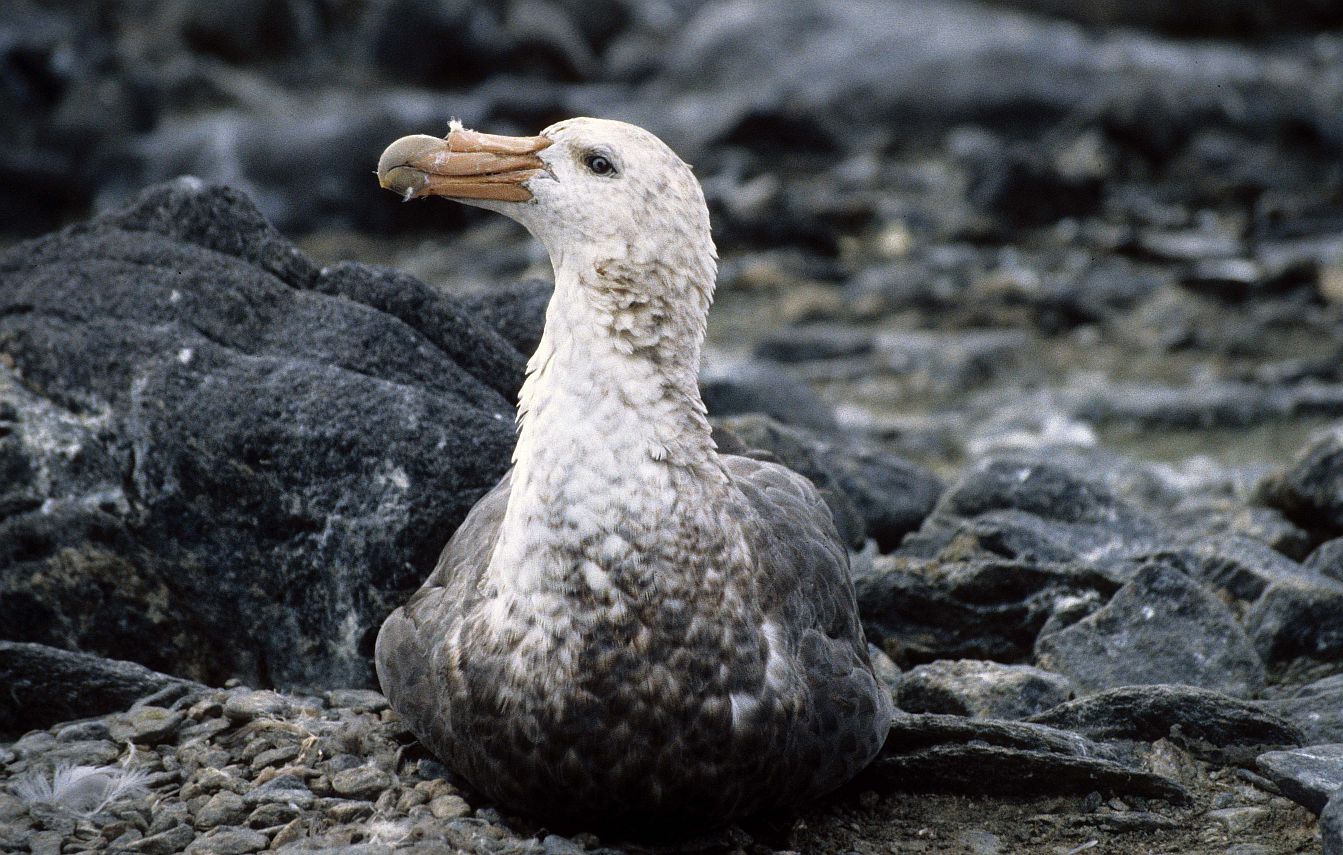 Southern Giant Petrel breeding on the Frazier Islands, East Antarctica, photograph by Jeroen Creuwels
Colin Southwell (Australian Antarctic Division, Kingston, Tasmania, Australia) and colleagues have published open access in the journal Diversity and Distributions on mapping seabird colonies in Antarctica, including of the ACAP-listed Southern Giant Petrel Macronectes giganteus.
The paper’s abstract follows:
“Aim
To map presence, absence and ignorance of Antarctic seabird breeding occupancy at the spatial resolution of ice-free habitat sites to identify knowledge gaps and inform management and conservation.
Location
East Antarctica between longitudes 30° E and 150° E.
Methods
We develop a unifying spatial and inferential framework to compile and interpret observations of Antarctic seabird breeding occupancy. The spatial framework allowed consistent geo-referencing of observations at the spatial resolution of habitat sites. The compilation included published papers and datasets, unpublished reports, research station logs and unpublished field notes. Where possible, observations and inferences were validated by the ‘experts’ who originally collected data. The inferential framework categorised levels of uncertainty for inferring occupancy and distinguished knowledge of occupancy from ignorance.
Results
After a century of observations, there are still knowledge gaps in seabird breeding occupancy along large sections of the East Antarctic coastline and across most of continental East Antarctica where breeding habitat is available. The spatial extent of knowledge and ignorance is strongly dependent on the level of certainty used to infer absence. Observations are clustered close to permanently occupied research stations, most of which are located on the coast, and biased in favour of species that are most emblematic of Antarctica or those with a less secure conservation status. The spatial and temporal coverage of observations in recent decades would be insufficient to effectively detect change in most species' breeding occupancy distributions across their range into the future.
Main Conclusions
Our compilation and mapping of occupancy data contributes to practical conservation measures to mitigate impacts of human activities including aviation and fisheries on seabirds in Antarctica, and serves as a foundation to strategically improve future environmental management and conservation. We urge future occupancy monitoring to explicitly report the location of search effort and potential absence in addition to presence and to aim to close spatial knowledge gaps.”
Read a popular article on the publication here.
Reference:
Colin Southwell, Louise Emmerson, Nat Kelly, Dale Maschette, John Arnould, Christophe Barbraud, Jeroen Creuwels, Robyn Delaney, Karine Delord, John Gibson, Ken Green, Mark Hindell, Harold Heatwole, Peter Hodum, Cindy L. Hull, Akiko Kato, Nobuo Kokubun, Anna Lashko, Gary Miller, Ian Norman, Frederique Olivier, Anant Pande, Graham Robertson, Marcus Salton, Akinori Takahashi, Jan van Franeker, Simon Ward, Barbara Wieneke & Eric J. Woehler 2025. Mapping Antarctic seabird breeding occupancy from a century of observations to inform environmental management and conservation. Diversity and Distributions 31(9). e70066.
John Cooper, Emeritus Information Officer, Agreement on the Conservation of Albatrosses and Petrels, 02 January 2026