
 English
  Français
  Español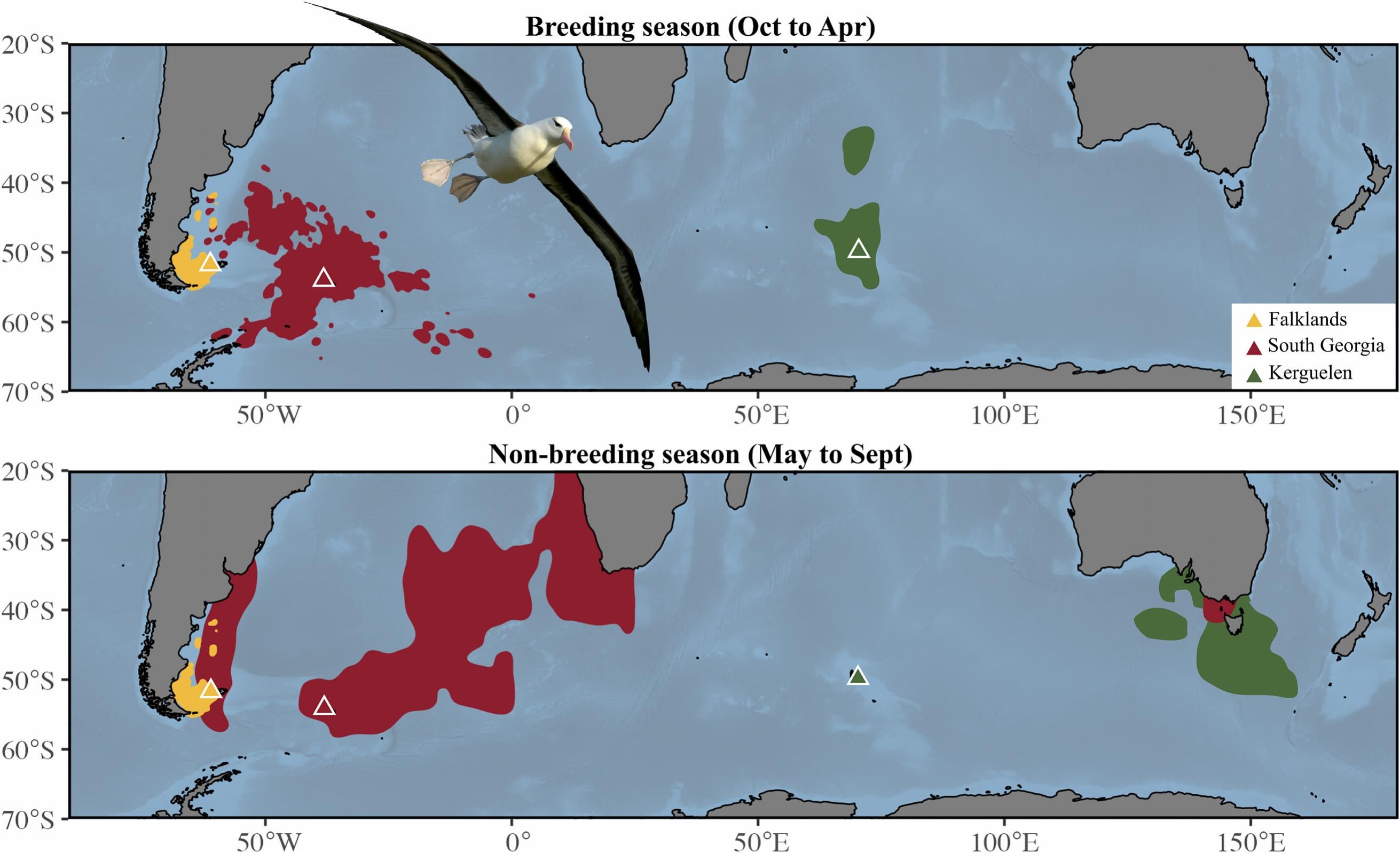
At-sea distribution of three monitored Black-browed albatross populations (marked by triangles) during the breeding and non-breeding seasons. For each colony, the distribution contours encompass 90% of the kernel utilization distribution, from the publication
Francesco Ventura (Department of Physical Oceanography, Woods Hole Oceanographic Institution, Massachusetts, USA) and colleagues have published in the journal Biological Conservation on the population dynamics of immature Black-browed Albatrosses Thalassarche melanophris.
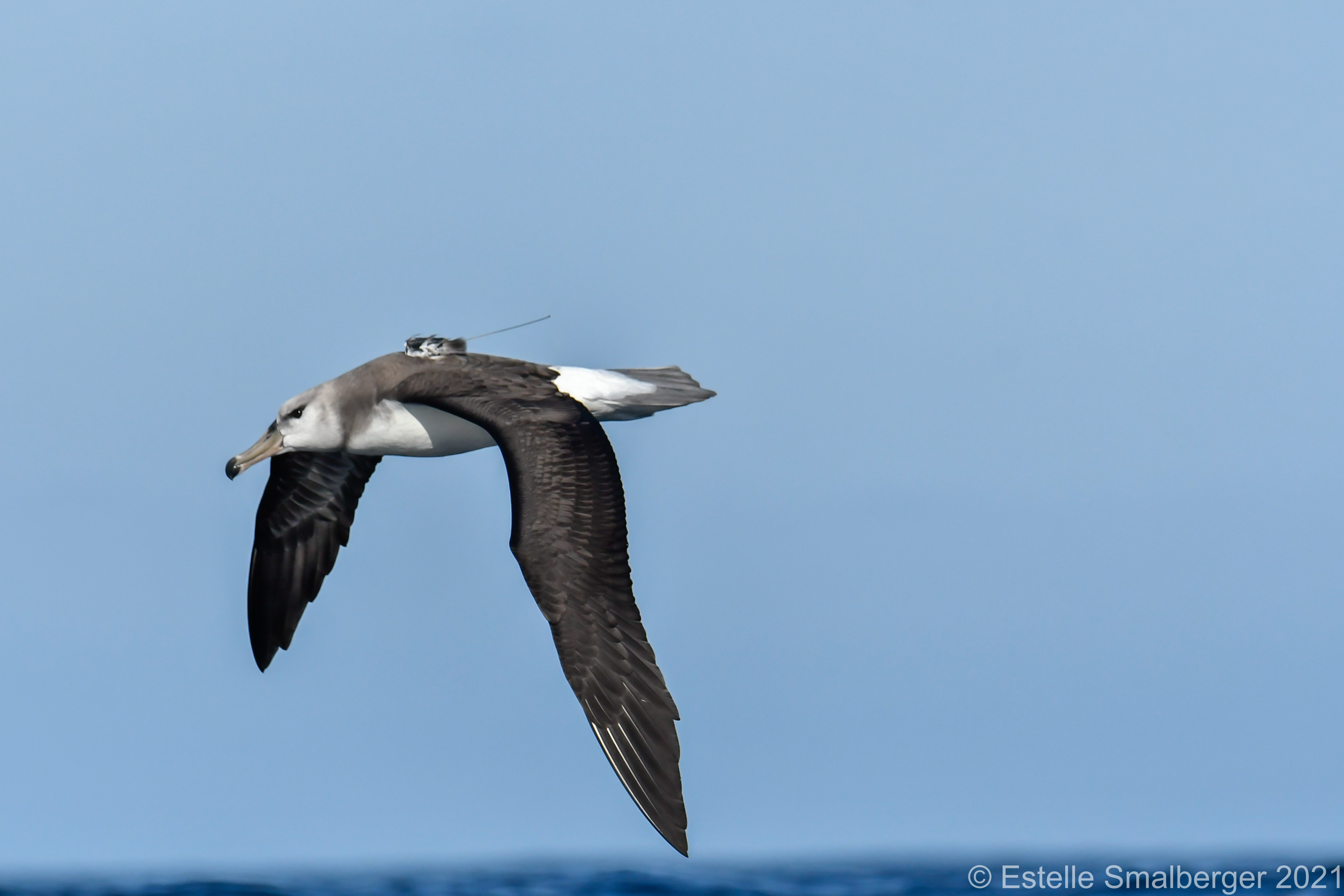 An immature Black-browed Albatross with a tracking device, photograph by Estelle Smalberger
The paper’s abstract follows:
“Demographic assessments are essential for effective biological conservation management, allowing early detection of population declines and timely allocation of resources to avoid possible crises. For species with slow life-history strategies like seabirds, only the breeding adults are monitored routinely. The dynamics of immatures, often unobservable from fledging to recruitment, are less well understood and typically not accounted for in conservation status assessments.
Here, we quantify the importance of changes in the survival and abundance of immatures in shaping the past and forecasted dynamics of a long-lived marine top-predator. We use integrated population models (IPM) incorporating the dynamics of immatures, based on multi-decadal demographic monitoring of the black-browed albatross (Thalassarche melanophris) at three globally important breeding sites.
The populations showed differences in breeding and survival rates, highlighting a degree of life history flexibility in response to the environment. Using a retrospective sensitivity analysis, we consistently identified immature survival as the key contributor to population growth rate. At all sites, even those with increasing or stable breeding populations, the total population has been declining, largely due to decreases in immature survival. Although not directly apparent from counts, this decline is already underway and is projected to emerge at the level of the breeding population over the coming three generations. This contrasts with a model focusing solely on counts of breeding adults, which mostly indicate an overall population increase.
Collectively, our findings highlight that conservation assessments must account for the dynamics of subadult stages, or risk providing an inaccurate picture of population status.”
With thank to Richard Phillips, British Antarctic Survey,
Reference:
Ventura, F., Che-Castaldo, C., Catry, P., Delord, K., Kuepfer, A., Mohring, B., Oppel, S., Phillips, R.A., Rouby, E., Ummenhofer, C.C., Weimerskirch, H., Wood, A.G., Barbraud, C. & Jenouvrier, S. 2026. Flying under the radar: the demographic importance of immatures in long-lived seabird populations. Biological Conservation 323, 112102.
John Cooper, Emeritus Information Officer, Agreement on the Conservation of Albatrosses and Petrels, 10 September 2026