The Agreement on the Conservation of Albatrosses and Petrels

We strive, through our 13 Parties, to conserve albatrosses and petrels by coordinating international activities to mitigate threats to their populations.  In 2019 ACAP’s Advisory Committee declared that a conservation crisis continues to be faced by its 31 listed species, with thousands of albatrosses, petrels and shearwaters dying every year as a result of fisheries operations.  To increase awareness of this crisis ACAP inaugurated a World Albatross Day to be held annually on 19 June from 2020, the date the Agreement was signed in 2001.

Read More


RESOURCES

Best Practice Advice

ACAP review of seabird bycatch mitigation measures and summary advice for reducing the impact of fishing on seabirds.

View Resources

RESOURCES

Seabird-Safe Fishing Toolkit

An interactive website for longline tuna fisheries. It provides guidance based on ACAP’s Best Practice Advice on how to avoid catching seabirds and ensure good practice. Identify where threatened seabirds range, assess current state of seabird-safe fishing, and explore how to improve seabird safety over time.

Go to Toolkit

RESOURCES

Mitigation Fact Sheets

The Seabird Bycatch Mitigation Fact Sheets describe the range of potential mitigation measures available to reduce seabird bycatch in longline and trawl fisheries.

View Resources

RESOURCES

Seabird Bycatch Identification Guide

The Guide is primarily intended for use at sea by fisheries observers to assist in the identification of albatrosses, petrels and shearwaters commonly caught in longline operations.

View Resources

DOCUMENTS

Text of the Agreement

Amended by the Sixth Session of the Meeting of the Parties, Skukuza, South Africa, 7 - 11 May 2018.

View Document

RESOURCES

ACAP Species

The ACAP Species Assessments contain the most recent scientific information regarding albatross and petrel species listed under the Agreement.

View Resources

RESOURCES

Data Portal

Population and conservation data for species listed on Annex 1 of ACAP. Reporting on implementation of the Agreement.

Go to Data Portal

Upcoming Meetings and Events

ACAP representatives actively engage in meetings of organisations that impact the status of ACAP-listed species - View all upcoming meetings and events

27 - 29 May 2026
Swakopmund, Namibia
13th Meeting of ACAP's Seabird Bycatch Working Group (SBWG13)
01 - 05 Jun 2026
Swakopmund, Namibia
15th Meeting of ACAP’s Advisory Committee (AC15)
08 - 16 Aug 2026
Oslo, Norway
12th SCAR Open Science Conference & Meetings


Graham Robertson (Kingston, Tasmania, Australia) and colleagues have published in the journal Polar Biology on population increases of Black-browed Thalassarche melanophris and Grey-headed T. chrysostoma Albatrosses on Chilean islands.
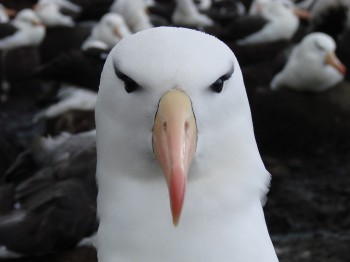
Black-browed Albatross
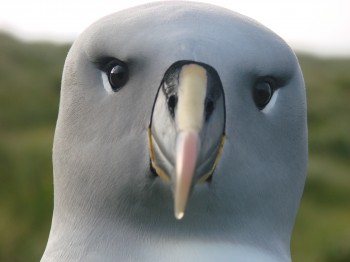
 GHA Suazo

Grey-headed Albatross, photographs by Cristián Suazo

The paper’s abstract follows:

“Black-browed albatrosses (Thalassarche melanophris) are killed incidentally in commercial fishing operations.  Aerial surveys in 2002 and 2011 revealed the number of black-browed albatrosses at the Diego Ramírez and Ildefonso islands, Chile, increased by 52 and 18 %, respectively.  The increases were attributed to reduced mortality in the longline fishery for Patagonian toothfish (Dissostichus eleginoides) following fleet conversion to a new gear configuration with much higher average hook sink rates.  A new survey in 2014 revealed the number of black-browed albatrosses at Ildefonso was about the same as in 2011, but the number at Diego Ramírez had increased by a further 29 % (8.8 %/year).  The number of greyheaded albatrosses (Thalassarche chrysostoma) at Diego Ramírez also increased, by 23 %, in the same time period.  In 2014, Ildefonso held an estimated 54,284 breeding pairs of black-browed albatrosses.  The populations of blackbrowed albatrosses at two more northern sites, the Evangelistas and Leonard islets, stood at 4818 and 545 breeding pairs, respectively.  The total number of breeding pairs of both albatross species at Diego could not be determined because not all islands in the archipelago were surveyed.”
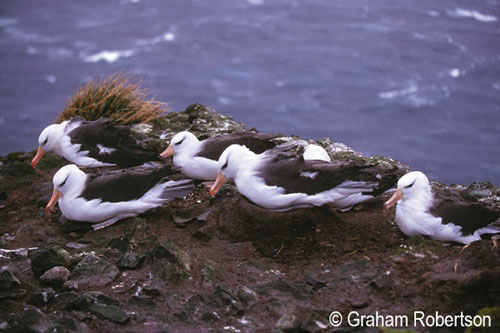
Black-browed Albatrosses hunker down on their nests in strong wind on a Chilean Island, photograph by Graham Robertson

With thanks to Cristián Suazo.

Reference:

Robertson, G., Wienecke, B., Suazo, C.G., Lawton, K., Arata, J.A. & Moreno, C. 2016.  Continued increase in the number of black-browed albatrosses (Thalassarche melanophris) at Diego Ramírez, Chile.  Polar Biology DOI 10.1007/s00300-016-2028-5.

John Cooper, ACAP Information Officer, 05 October 2016

Subscribe to the ACAP Newsletter

The Agreement on the
Conservation of Albatrosses and Petrels

ACAP is a multilateral agreement which seeks to conserve listed albatrosses, petrels and shearwaters by coordinating international activity to mitigate known threats to their populations.

About ACAP

ACAP Secretariat

119 Macquarie St
Hobart TAS 7000
Australia

Email: secretariat@acap.aq
Tel: +61 3 6165 6674