The Agreement on the Conservation of Albatrosses and Petrels

We strive, through our 13 Parties, to conserve albatrosses and petrels by coordinating international activities to mitigate threats to their populations.  In 2019 ACAP’s Advisory Committee declared that a conservation crisis continues to be faced by its 31 listed species, with thousands of albatrosses, petrels and shearwaters dying every year as a result of fisheries operations.  To increase awareness of this crisis ACAP inaugurated a World Albatross Day to be held annually on 19 June from 2020, the date the Agreement was signed in 2001.

Read More


RESOURCES

Best Practice Advice

ACAP review of seabird bycatch mitigation measures and summary advice for reducing the impact of fishing on seabirds.

View Resources

RESOURCES

Seabird-Safe Fishing Toolkit

An interactive website for longline tuna fisheries. It provides guidance based on ACAP’s Best Practice Advice on how to avoid catching seabirds and ensure good practice. Identify where threatened seabirds range, assess current state of seabird-safe fishing, and explore how to improve seabird safety over time.

Go to Toolkit

RESOURCES

Mitigation Fact Sheets

The Seabird Bycatch Mitigation Fact Sheets describe the range of potential mitigation measures available to reduce seabird bycatch in longline and trawl fisheries.

View Resources

RESOURCES

Seabird Bycatch Identification Guide

The Guide is primarily intended for use at sea by fisheries observers to assist in the identification of albatrosses, petrels and shearwaters commonly caught in longline operations.

View Resources

DOCUMENTS

Text of the Agreement

Amended by the Sixth Session of the Meeting of the Parties, Skukuza, South Africa, 7 - 11 May 2018.

View Document

RESOURCES

ACAP Species

The ACAP Species Assessments contain the most recent scientific information regarding albatross and petrel species listed under the Agreement.

View Resources

RESOURCES

Data Portal

Population and conservation data for species listed on Annex 1 of ACAP. Reporting on implementation of the Agreement.

Go to Data Portal

Upcoming Meetings and Events

ACAP representatives actively engage in meetings of organisations that impact the status of ACAP-listed species - View all upcoming meetings and events

27 - 29 May 2026
Swakopmund, Namibia
13th Meeting of ACAP's Seabird Bycatch Working Group (SBWG13)
01 - 05 Jun 2026
Swakopmund, Namibia
15th Meeting of ACAP’s Advisory Committee (AC15)
08 - 16 Aug 2026
Oslo, Norway
12th SCAR Open Science Conference & Meetings


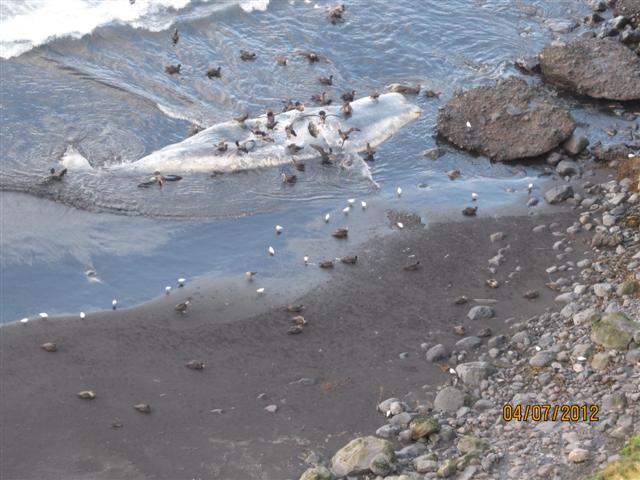
Ship's Cove is one of the few sandy beaches on South Africa's sub-Antarctic Marion Island in the southern Indian Ocean and is home to hundreds of seabirds from loafing King Penguins Aptenodytes patagonicus on the beach to Sooty Albatrosses Phoebetria fusca breeding on the steep cliffs above.  Giant petrels Macronectes spp. are used to squabbling over the occasional King Penguin meal in the cove, but since a 15-m long Sperm Whale Physeter catadon carcass washed up on 9 June this year there has been food aplenty for them.

Four weeks later and the carcass is still fairly intact, and although it is getting shifted about with the waves and currents it seems to have settled on the eastern side of the cove.  Up to 65 ACAP-listed Northern M. halli and Southern Giant Petrels M. giganteus as well as up to 47 Lesser Sheathbills Chionis minor have been recorded at any one time scattered all over the blubbery mass.  The overwintering team based on the island have all had a good gawk, although it is now getting quite ripe so the carcass is losing its appeal.  Not so for the hoard of giant petrels which continue to scrabble and compete for food with wings outstretched and tails held vertical; for them this is a welcome food source in the middle of winter.
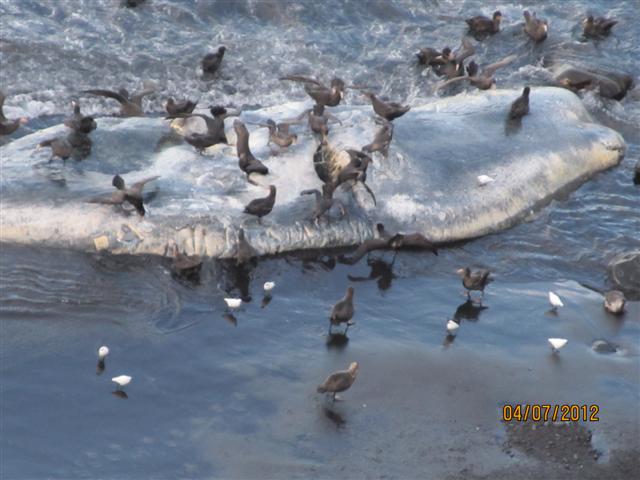
 

Ron Summers counted 58 giant petrels still feeding on the remains of 14 beached Sperm Whales in the South Atlantic that had washed ashore fully 14 months previously.  How long will Marion's whale last as a giant petrel feast?

Reference:

Summers, R.W. 1979.  Giant Petrels feeding on 14 month-old whale carcasses.  Cormorant 7: 33.

With thanks to Linda Clokie, Jacqui Davis and John Lucas for information and photographs.

Ben Dilley, FitzPatrick Institute, University of Cape Town and John Cooper, ACAP Information Officer, 23 July 2012


Subscribe to the ACAP Newsletter

The Agreement on the
Conservation of Albatrosses and Petrels

ACAP is a multilateral agreement which seeks to conserve listed albatrosses, petrels and shearwaters by coordinating international activity to mitigate known threats to their populations.

About ACAP

ACAP Secretariat

119 Macquarie St
Hobart TAS 7000
Australia

Email: secretariat@acap.aq
Tel: +61 3 6165 6674