The Agreement on the Conservation of Albatrosses and Petrels

We strive, through our 13 Parties, to conserve albatrosses and petrels by coordinating international activities to mitigate threats to their populations.  In 2019 ACAP’s Advisory Committee declared that a conservation crisis continues to be faced by its 31 listed species, with thousands of albatrosses, petrels and shearwaters dying every year as a result of fisheries operations.  To increase awareness of this crisis ACAP inaugurated a World Albatross Day to be held annually on 19 June from 2020, the date the Agreement was signed in 2001.

Read More


RESOURCES

Best Practice Advice

ACAP review of seabird bycatch mitigation measures and summary advice for reducing the impact of fishing on seabirds.

View Resources

RESOURCES

Seabird-Safe Fishing Toolkit

An interactive website for longline tuna fisheries. It provides guidance based on ACAP’s Best Practice Advice on how to avoid catching seabirds and ensure good practice. Identify where threatened seabirds range, assess current state of seabird-safe fishing, and explore how to improve seabird safety over time.

Go to Toolkit

RESOURCES

Mitigation Fact Sheets

The Seabird Bycatch Mitigation Fact Sheets describe the range of potential mitigation measures available to reduce seabird bycatch in longline and trawl fisheries.

View Resources

RESOURCES

Seabird Bycatch Identification Guide

The Guide is primarily intended for use at sea by fisheries observers to assist in the identification of albatrosses, petrels and shearwaters commonly caught in longline operations.

View Resources

DOCUMENTS

Text of the Agreement

Amended by the Sixth Session of the Meeting of the Parties, Skukuza, South Africa, 7 - 11 May 2018.

View Document

RESOURCES

ACAP Species

The ACAP Species Assessments contain the most recent scientific information regarding albatross and petrel species listed under the Agreement.

View Resources

RESOURCES

Data Portal

Population and conservation data for species listed on Annex 1 of ACAP. Reporting on implementation of the Agreement.

Go to Data Portal

The Convention on International Trade in Endangered Species of Wild Fauna and Flora (CITES) is an international agreement between governments that came into force in 1975.  Its aim is to ensure that international trade in specimens of wild animals and plants does not threaten their survival.  CITES currently has 177 Parties.

The Convention's three appendices list species afforded different levels or types of protection from over-exploitation (click here).  Appendix I lists species that are the most endangered among CITES-listed animals and plants.  Appendix II lists species that are not necessarily now threatened with extinction but that may become so unless trade is closely controlled.  Appendix III is a list of species included at the request of a Party that already regulates trade in the species and that needs the cooperation of other countries to prevent unsustainable or illegal exploitation.

The only procellariiform seabird currently listed within CITES is the ACAP-listed Vulnerable Short-tailed Albatross Phoebastria albatrus, listed in Appendix I on 1 July 1975 from the date the Convention came into force.  Practically the total population of the Short-tailed Albatross breeds within Japan, which became a Party to CITES in 1980.

Trade in the 30 species of ACAP-listed albatrosses and petrels is a thing of the past and it is now a long time since the slowly-recovering Short-tailed Albatross was exploited to near-extinction for its feathers during the 19th and first half of the 20th Centuries.
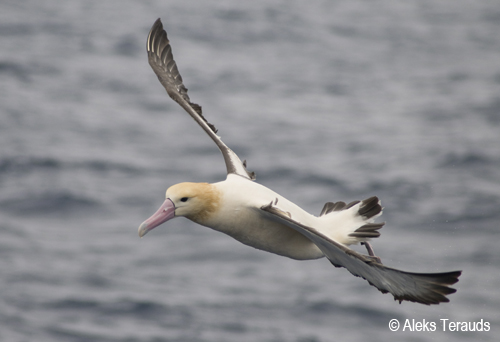
Short-Tailed_Albatross_by_Aleks_Terauds1
Short-tailed Albatross.  Photograph by Aleks Terauds

John Cooper, ACAP Information Officer, 8 January 2013

Subscribe to the ACAP Newsletter

The Agreement on the
Conservation of Albatrosses and Petrels

ACAP is a multilateral agreement which seeks to conserve listed albatrosses, petrels and shearwaters by coordinating international activity to mitigate known threats to their populations.

About ACAP

ACAP Secretariat

119 Macquarie St
Hobart TAS 7000
Australia

Email: secretariat@acap.aq
Tel: +61 3 6165 6674