
 English
  Français
  Español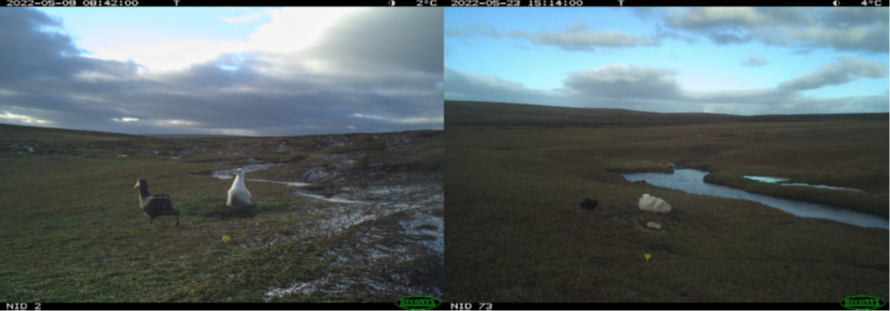
“Albatross chick reaction when facing a Southern Giant Petrel (left) and a cat (right)”, from the publication
Anais Cotton (Centre de Recherche sur la Biodiversité et l’Environnement, Université de Toulouse, France) and colleagues have published open access in the Journal of Comparative Physiology A on the responses of Wandering Albatross Diomedea exulans chicks to feral cats on France’s Kerguelen Island.
The paper’s abstract follows:
“In long-standing predator-prey systems, prey typically evolve costly responses to predation risk. How prey respond to novel predators is less investigated. We explored physiological (corticosterone, triglyceride), morphological (body condition) and behavioural (defensive posture) responses of wandering albatross (Diomedea exulans) chicks to a novel predator, the feral cat (Felis catus) in Kerguelen archipelago. We implemented a semi-experimental design to increase the variance in cat abundance by regulating cat populations in certain zones of the study colony. The aforementioned chick traits were then monitored and analysed at the zone scale, by comparing nests located within regulated and non-regulated zones, and at the nest scale, by recording cat abundance through intensive camera traps monitoring. This fine-scale approach further enabled us to investigate how chicks responded to southern giant petrels (Macronectes giganteus), an opportunistic predator-scavenger that has co-evolved with albatrosses. Cat abundances had no effect on chick traits. In contrast, higher abundances of giant petrel were associated with an elevated rate of corticosterone increase and lower triglyceride levels. In accordance with these results suggesting a more accurate perception of predation risk mediated by giant petrels than by cats, chicks were more prone to display a defensive posture when facing a giant petrel than a cat. We discuss these results in the light of contrasting evolutionary histories and predation patterns between albatrosses and their predators, and we emphasise that studies of predator impacts on prey populations must consider both the direct and indirect effects of all predators, as well as their interactions.”
Reaf more about feral cats on Kerguelen here.
Reference:
Cotton, A., Barbraud, C., Leclaire, S., Delord, K., Bodin, A., Stier, A., Ribout, C., Parenteau, C., Ferdy, J.-B., Bourgoin, C., White, J., Angelier, F. & Blanchard, P.2026. Physiological and behavioural responses of wandering albatross chicks (Diomedea exulans) to novel and non-novel predators. Journal of Comparative Physiology A doi.org/10.1007/s00359-026-01793-6.
John Cooper, Emeritus Information Officer, Agreement on the Conservation of Albatrosses and Petrels, 09 April 2026