
 English
  Français
  Español
 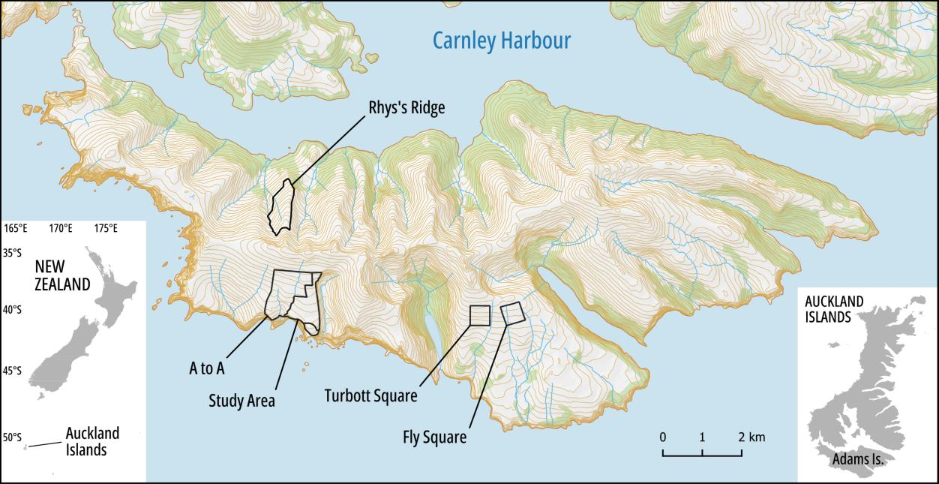 Adams Island, showing the Study Area (61 ha); the three census blocks in which counts of breeders have historically been made: Amherst to Astrolabe (A to A; 101 ha), Rhys’s Ridge (67 ha), and Fly Square (25ha); and the fourth census block added in January 2026: Turbott Square (25 ha), from the report
The final report for the Conservation Services Programme project, POP2025-04 Auckland Islands seabird research: Gibson’s albatross, by Johannes Chambon (Department of Conservation, Dunedin, New Zealand) and colleagues, is now available. It shows the population of the subspecies gibsoni of the Endangered Antipodean Albatross has halved on Adams Island, Auckland Islands since 2005.
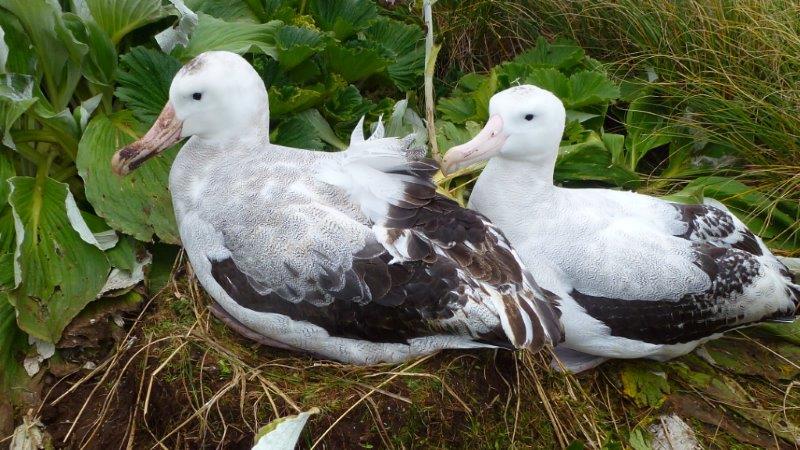 A Gibson’s Antipodean Albatross breeding pair among the megaherb Campbell Island Daisy Pleurophyllum speciosum on Adams Island, photograph by Colin O'Donnell
The report’s summary follows:
“Gibson’s albatross (Diomedea antipodensis gibsoni) has been in decline since 2005. Research into the causes of and solutions to the falling numbers of Gibson’s wandering albatross includes an annual visit to the main breeding grounds on Adams Island, and this report describes the results of the field programme in the 2025/2026 breeding season. Breeding success in 2025 was 60%, with 83 chicks produced in the study area, all of which were banded before fledging. Mean adult female survival in 2014-2024 at 93% remains slightly lower than the mean 95% before the 2005 population crash. To increase the proportion of the total breeding population ground-counted annually, a new census block was demarcated and counted in 2026: Turbott Square, within the high-density Fly Basin colony. This brings the proportion of the total Adams Island breeding population ground-counted annually to 12.4% rather than 10% counted formerly. A total of 5,032 pairs were estimated to be breeding on Adams Island in 2026, comparable to 2025 (4,865 pairs). The total number of Gibson’s albatross breeding pairs remains half the size of the pre-crash nesting population.”
Reference:
Chambon, J., Elliott, G., Walker, K. & Watts, J. 2026. Gibson’s wandering albatross demography and population estimate 2026. Wellington: Conservation Services Programme, Department of Conservation. 16 pp.