
 English
  Français
  Español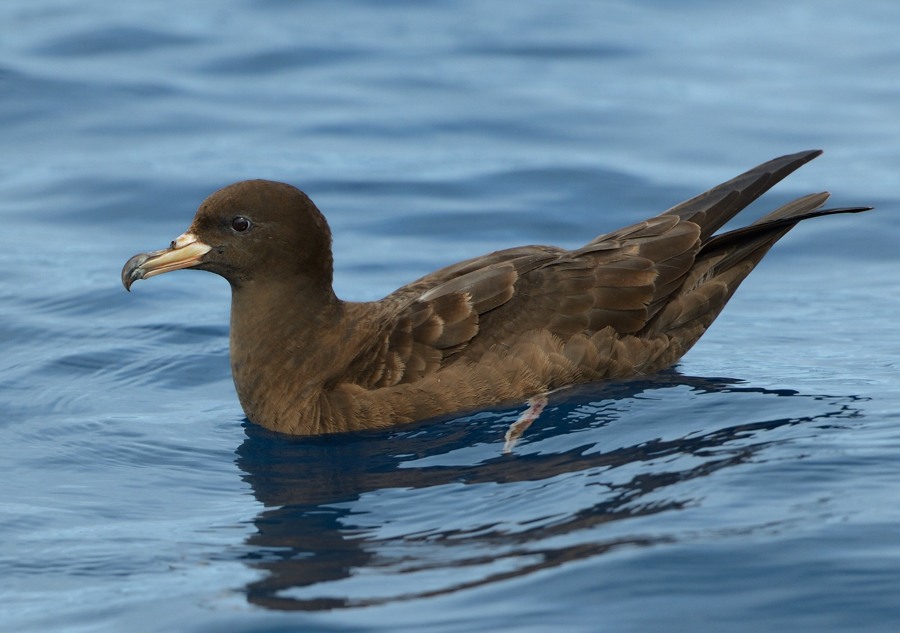
Flesh-footed Shearwater at sea, photograph by Kirk Zufelt
Parties to the Convention on the Conservation of Migratory Species of Wild Animals (CMS) have submitted proposals to add 27 species of procellariiform seabirds to CMS appendices. The proposed amendments to the appendices were reviewed and commented on at the 8th Meeting of the Sessional Committee of the CMS Scientific Council (ScC-SC8), held over 15 to 18 December 2025 in Bonn, Germany, prior to their formal consideration at the 15th Meeting of the Conference of the Parties to CMS (COP15), to be held in Campo Grande, Brazil from 23 to 29 March 2026.
The 27 seabirds include the Near threatened Flesh-footed Shearwater Ardenna carneipes, proposed to be listed on Appendix II by Australia, France and New Zealand, the sole breeding range states for the species. The Sessional Committee supported the proposal and noted the species is facing various threats, such as climate change and bycatch in fisheries, adding that listing will strengthen cooperation to tackle threats and reduce them.
The Flesh-footed Shearwater was considered for listing by ACAP at its 2019 meeting, but as yet no formal proposal to the Parties has been made. Some of the 31 species of albatrosses, petrels and shearwaters listed by ACAP are also included in CMS appendices, which preceded their listing by ACAP. These include the Vulnerable Pink-footed Shearwater A. creatopus (Appendix I) and the Critically Endangered Balearic Shearwater Puffinus mauretanicus (Appendix I).
According to the CMS, Appendix II lists migratory species which have an unfavourable conservation status, and which require international agreements for their conservation and management. It also includes species whose conservation status would significantly benefit from the international cooperation that could be achieved by an international agreement. It thus seems that a pathway is opening for ACAP (which itself is a CMS instrument) to be that “international agreement” and consider listing the Flesh-footed Shearwater, especially since the three countries proposing the species for Appendix II listing are also Parties to the Albatross and Petrel Agreement.
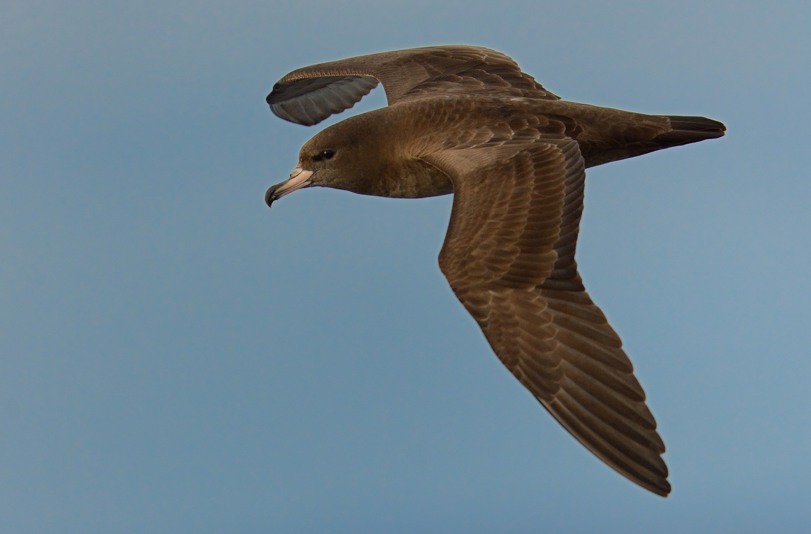
Flesh-footed Shearwater in flight, photograph by Kirk Zufelt
In addition, 26 gadfly petrel taxa in the genera Pseudobulweria and Pterodroma have been proposed for listing by Australia, Brazil, Chile, Cook Islands, Dominican Republic, Fiji and New Zealand. Nine taxa are proposed for Appendix I and 17 for Appendix II. The Sessional Committee supported the inclusion of the proposed species, commending New Zealand for its leadership. Click here for a full list of the 26 gadfly petrels and to which appendix they are proposed for inclusion.
Appendix I comprises migratory species that have been assessed as being in danger of extinction (“facing a very high risk of extinction in the wild in the near future”) throughout all or a significant portion of their range.
ACAP Latest News will report on the outcomes of COP15 and also give links to the supporting documents for each taxon once they become available in the new year.
Selected Publications:
Baker, G.B. & Wise, B.S. 2005. The impact of pelagic longline fishing on the Flesh-footed Shearwater Puffinus carneipes in eastern Australia. Biological Conservation 126: 305-316.
Cooper, J. & Baker, G.B. 2008. Identifying candidate species for inclusion within the Agreement on the Conservation of Albatrosses and Petrels. Marine Ornithology 36 1-8.
Jamieson, S.E. & Waugh, S.M. 2015. An assessment of recent population trends of flesh-footed shearwaters (Puffinus carneipes) breeding in New Zealand. Notornis 62: 8-13.
Lavers, J.L. 2014. Population status and threats to Flesh-footed Shearwaters (Puffinus carneipes) in South and Western Australia. ICES Journal of Marine Science: 72: 316-327.
Priddel, D., Carlile, N., Fullagar, P., Hutton, I. & O’Neill, L. 2006. Decline in the distribution and abundance of flesh-footed shearwaters (Puffinus carneipes) on Lord Howe Island, Australia. Biological Conservation 128: 412-424.
John Cooper, Emeritus Information Officer, Agreement on the Conservation of Albatrosses and Petrels, 22 December 2025
NOTE: ACAP Monthly Missives are more personal than those news articles that are regularly posted in ACAP Latest News. The series offers the opportunity to go behind and beyond factual events and current news, giving opinions on matters related to the conservation of all the members of the tubenose group of birds. The opinions expressed in ACAP Monthly Missives are not to be taken as those of the ACAP Secretariat or any of the Agreement’s Parties.