
 English
  Français
  Español
 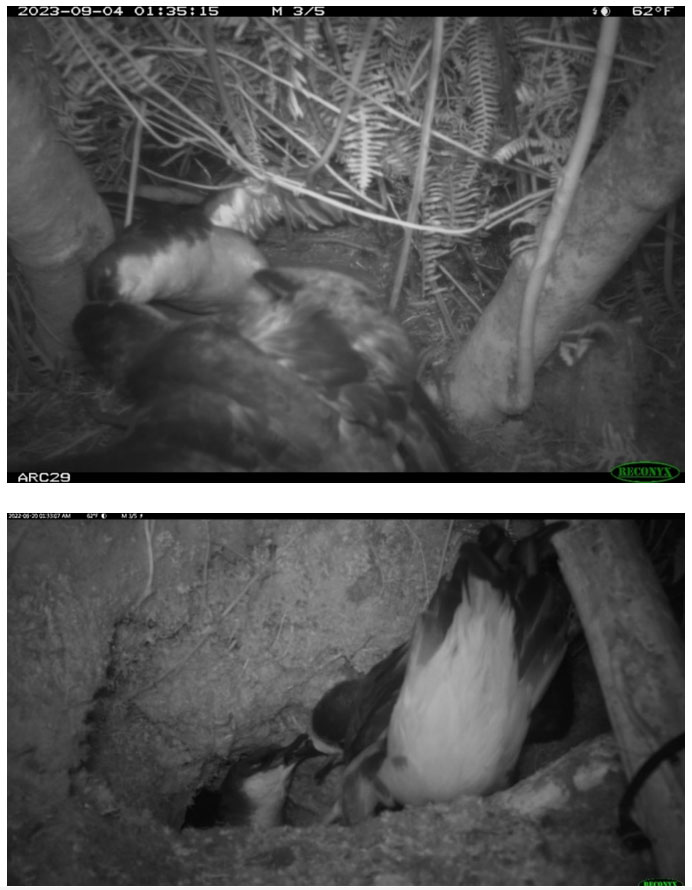 An adult Hawaiian Petrel fights with a Newell’s Shearwater outside its burrow (from the publication)
André Raine (Archipelago Research and Conservation, Kauai, Hawaii, USA) and colleagues have published open access in the journal Avian Conservation & Ecology on interspecific competition in three procellariid species on the Hawaiian island of Kauai.
An aggressive interaction between a Hawaiian Petrel and a Newell’s Shearwater at the latter’s burrow
The paper’s abstract follows:
“Colony creation projects are a vital tool for the recovery of threatened and endangered seabird populations and have significant conservation value by creating colonies inside highly protected and more easily managed areas. However, project sites need to be carefully chosen using a wide range of criteria to maximize success. One of these criteria is the potential for interactions with species already breeding within the site, in particular the possibility of interspecific competition. We considered three species of Procellariids in Hawaiʻi - two endangered Hawaiian endemics, the ʻuaʻu (Hawaiian Petrel, Pterodroma sandwichensis) and the ʻaʻo (Newell’s Shearwater, Puffinus newelli) and one native, the Wedge-tailed Shearwater (Ardenna pacifica) - to assess the prevalence of interspecific competition. Colony monitoring was conducted at six management sites on the island of Kauaʻi, one on the coast and five in the mountains. Cameras were deployed at breeding burrows and any interactions between species recorded. Interspecific competition was recorded at all sites. At the coastal site, Wedge-tailed Shearwaters consistently attacked breeding pairs of ʻaʻo and ultimately evicted 55.6% of established breeding pairs and 87.5% of prospectors. At montane management sites, aggressive interactions were recorded between ʻuaʻu and ʻaʻo at all sites and increased over time in tandem with population increases. Colony creation is an essential component of seabird conservation worldwide but, as this study shows, the presence of other breeding seabird species needs to be considered in the planning process if these projects are to succeed. This is particularly true if Wedge-tailed Shearwaters are already present (or could recolonize the site) and/or if the site already has a high density of a breeding species that is of a similar size and utilizes the same breeding habitat and breeding strategy.”
Reference:
Raine, A.F., Driskill, S., McFarlin, M., Brittingham, R., Rothe, J.A. & Raine, H. 2026. Interspecific competition among Procellariids: implications for seabird management and colony creation projects. Avian Conservation & Ecology 21(1). doi.org/10.5751/ACE-02962-210101.
John Cooper, Emeritus Information Officer, Agreement on the Conservation of Albatrosses and Petrels, 16 January 2026