
 English
  Français
  Español
 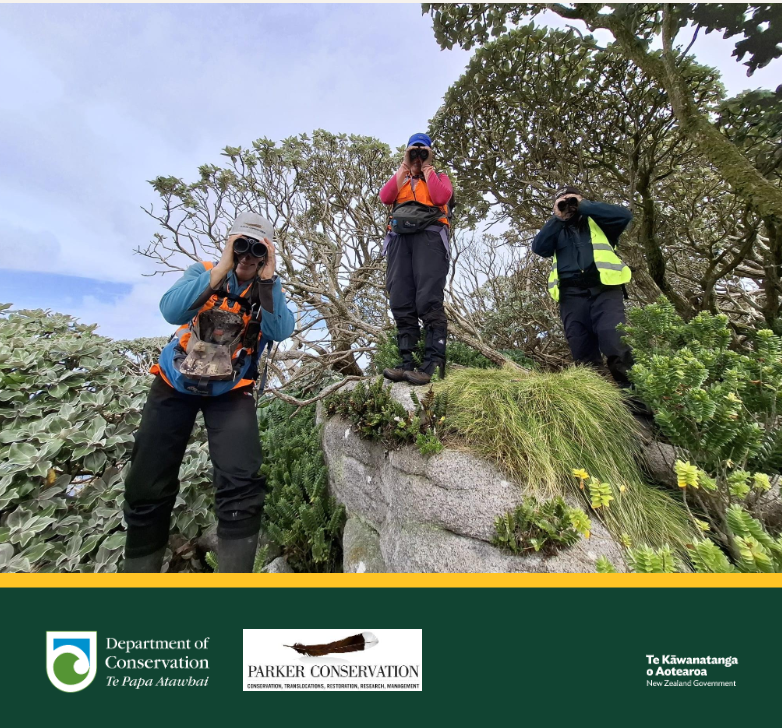 Researchers on The Snares, photograph by Graham Parker from the report’s title page
Paul Sagar (Parker Conservation) and colleagues have submitted their final report on field work conducted in 2026 on Near Threatened southern Buller’s Albatrosses Thalassarche b. bulleri at the Snares Island group to the Conservation Services Programme of New Zealand’s Department of Conservation.
The report’s Executive Summary follows:
“This report presents the results of demographic studies of southern Buller’s albatrosses Thalassarche bulleri bulleri breeding at Tini Heke | The Snares from 26 February to 22 March 2026. A whole-island count of the numbers of breeding pairs on North East Island and Broughton Island was attempted. This was largely successful, as ~78.5% of the Snares population was counted (South West Promontory and Alert Stack could not be fully counted). A total of 6,041 occupied nests was estimated in counted areas on North East Island. A comparison of the estimates from comparable areas showed a decline from 5,812 pairs in 2014 to 5,296 in 2026, a decrease of 9% over the 12 years. The estimated number of breeding pairs on Broughton Island was 680, similar to the 621 pairs estimated in 2019. When accounting for unsurveyed areas and applying a correction for vantage-point counts, the Snares southern Buller’s albatross population was estimated at 8,194 breeding pairs in March 2026.
Demographic studies at the three study colonies on North East Island have been undertaken annually 1992–2026, with the exceptions of 2018 and 2021. Estimates of the numbers of breeding pairs in 2026, made by recording the contents of each nest mound, increased in all three study colonies compared to 2024, but numbers remain below the levels recorded 2010–2023. Assuming that the three study colonies are representative of changes across North East Island as a whole, the Buller’s albatrosses breeding population probably peaked in 2005–2006 and has since undergone marked annual variations, with a general decrease since 2010. To increase coverage, a new study area was established at South Punui, bringing the annually-monitored population to 3.6% of the whole.
A total of 422 birds that had been banded previously in the study colonies as breeding adults of unknown age were recaptured. A further 56 breeding birds were banded in the study colonies, presumed to be first-time breeders. The estimate of adult survival in 2025 was 0.85, one of the lowest recorded during the 34 years of this study. During 1992–2004 all chicks that survived to near-fledging in the study colonies were banded and their survival to return to the study colonies in subsequent years has been monitored. This year, 128 of these birds were recaptured, with 7 birds from cohorts banded in 1998 and 2004 recorded as breeding for the first time. This highlights the long-term monitoring required to obtain reliable estimates of survival of known-age birds across life cycle stages. In addition, five birds banded as near-fledging chicks in the study colonies in Sep 2013 and 2014 were recorded breeding for the first time. The process of fitting metal-banded birds with alphanumeric darvic bands was continued (darvics were fitted on 346 newly banded or recaptured birds).
Furthermore, tracking devices for high-resolution insights into foraging behaviour and flight characteristics were fitted on 28 Buller’s albatrosses. Seven were also paired with TDRs to record sub-surface behaviour. Finally, nest cameras to record data on breeding timing, productivity and nest survival rates were maintained, with 11 nest cameras recording for a further year.
Key recommendations are to extend the area covered by annual counts (including the area from the hut to the tip of the North Promontory) for more-precise trend estimates; and to record more resightings of banded birds to maximise the quality of key demographic parameter estimates by allowing for longer trips going forward.
Reference:
Sagar, P., Parker, G., Waipoua, T. & Rexer-Huber, K. 2026. Population studies of southern Buller’s albatrosses at Tini Heke | The Snares. Wellington: Conservation Services Programme, Department of Conservation. 26 pp.
John Cooper, Emeritus Information Officer, Agreement on the Conservation of Albatrosses and Petrels, 30 July 2026