
 English
  Français
  Español
 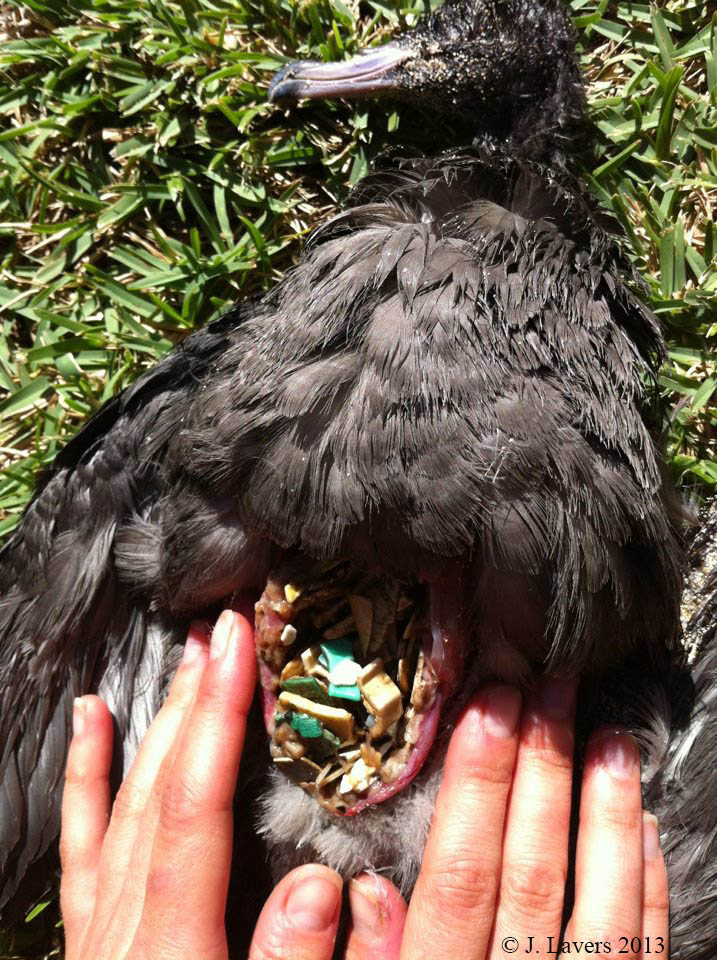 Plastic fragments in the alimentary system of a Flesh-footed Shearwater, photograph by Jennifer Lavers
Jennifer Lavers (Gulbali Institute, Charles Sturt University, Wagga Wagga, New South Wales, Australia) and colleagues have published open access in the journal PNAS on ingested plastics affecting the the Near threatened Flesh-footed Shearwater Ardenna carneipes at the population level.
The paper’s abstract follows:
“Plastics research lags 30 y behind many other environmental crises, with population-level impacts alluded to but not yet demonstrated for any wild species. Addressing this “Grand Challenge” requires robust data that span many years of variable exposure. Here, we use 15 y of mark-recapture data to estimate plastics’ impact on the demography of Sable Shearwaters (Ardenna carneipes). We found that the ingestion of >1 g of plastic is common and associated with at least an 11% reduction in the probability of birds surviving to return and breed at their natal island, with birds that ingested >5 g of plastic almost never seen again. In a time of unprecedented planetary change and biodiversity collapse, these results provide much- needed insight into plastics’ role in potentially driving species decline.”
Reference:
Lavers, J.L., Worthington, H. & Bond, A.L. 2026. Ingested plastics reduce recruitment and survival of an Australian seabird. PNAS doi/epdf/10.1073/pnas.2613782123.
John Cooper, Emeritus Information Officer, Agreement on the Conservation of Albatrosses and Petrels, 18 August 2026