
 English
  Français
  Español
  Marion Island SAPRI “birders” for 2024/25, Andile Kuzwayo and Jana Rau, photograph from SAPRI
The population demography of Vulnerable Wandering Albatrosses Diomedea exulans has been long, studied on South Africa’s Marion Island, with colour-banded birds in study colonies followed annually by a succession of field researchers since the mid 1980s.
Information on the 2024/25 breeding season in an article by field researchers Andile Kuzwayo and Jana Rau on the website of the South African Polar Research Infrastructure (SAPRI) has revealed an overall 63.2% breeding success (81.7% hatching success, 77.4% fledging success). The following long quote extracted from the article gives a flavour of the arduous field work conducted.
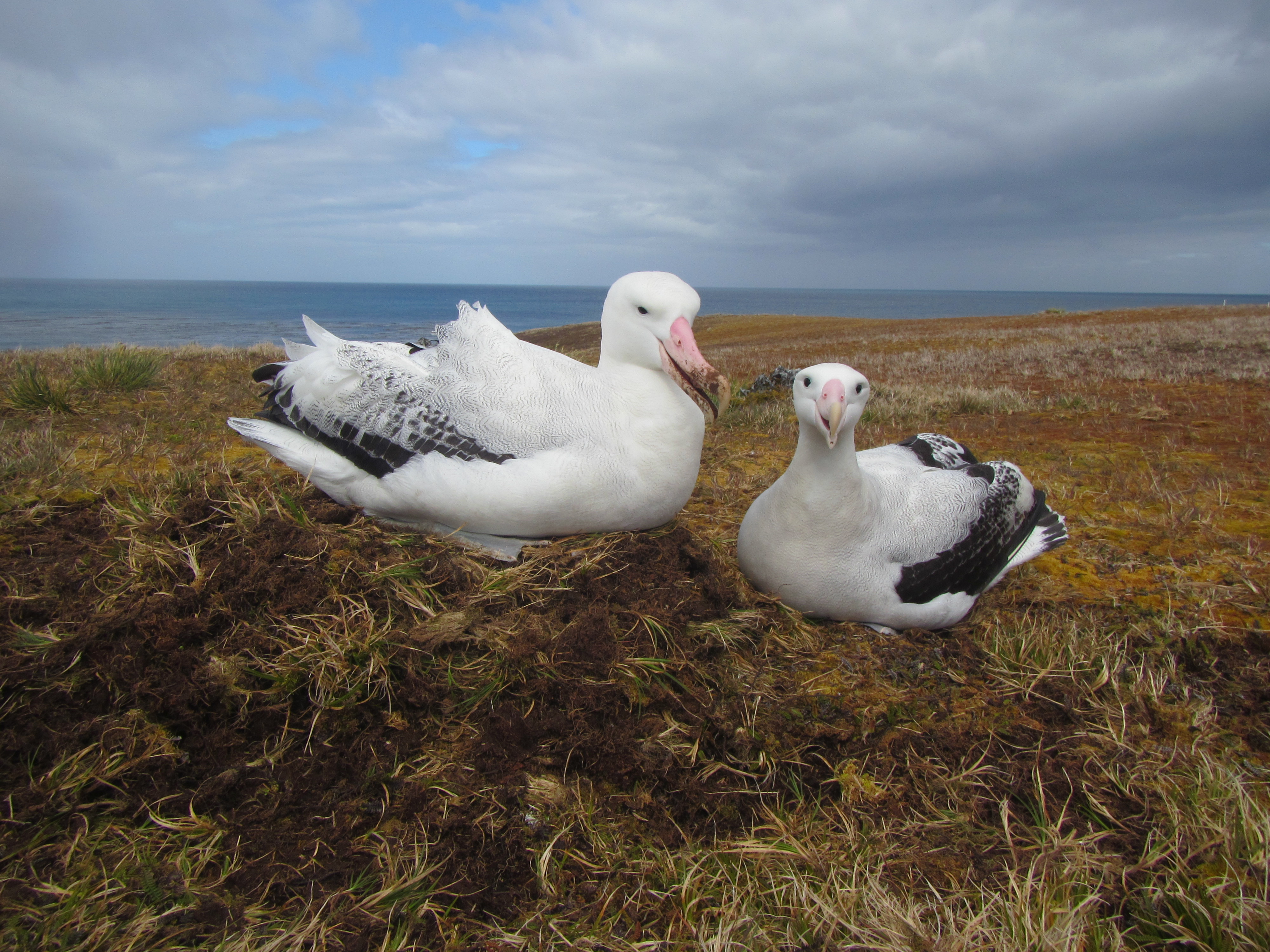 A Wandering Albatross pair on Marion Island; the larger, whiter male is on the newly-built nest, photograph by Danielle Keys
“This breeding success for 2025 is positive, being the second highest success over the last decade. We hope this positive trend will continue for this Vulnerable species. Breeding success on the island has fluctuated in the last 10 years, with the lowest breeding success being in 2024 possibly due to the devastating effects of the Highly Pathogenic Avian Influenza (HPAI) outbreak. In January 2026, we went on a quest to locate all the Walbie eggs on the island … and after ~500 km hiked cumulatively, 2776 eggs were found.
Monitoring involves visiting roughly 370 nests every 14 days in specific colonies. For all our species, checks include marking nest locations, and closely monitoring laying, hatching and fledging outcomes, chick and adult health, ring numbers, plastic pollution, and signs of mouse activity. Ringing is a main task for us, as it allows us to identify and track individual birds over their lifetimes. Ringing albatrosses and petrels is an unforgettable and special experience. Not only because you are faced with a snapping bill that can grow to ~19 cm long but also because chicks defend themselves by projectile vomiting fish-oil-rich stomach contents that never quite washes out of clothing … “Marion perfume” anyone?
A major threat to all our birds remains invasive house mice, which inflict severe, often fatal wounds on chicks and adults, with some injuries so severe they expose bone. Mouse eradication is one of the most urgent conservation priorities on the island.”
The article also gives information on two other long-term studies conducted on the island: on ACAP-listed Grey-headed Albatrosses Thalassarche chrysostoma and Northern Giant Petrels Macronectes giganteus.
Read about the 2026/27 seabird researchers who will shortly sail to spend a year on Marion Island to continue the long-term studies on the three ACAP-listed species here.
John Cooper, Emeritus Information Officer, Agreement on the Conservation of Albatrosses and Petrels, 20 July 2026