 English
  Français
  Español
 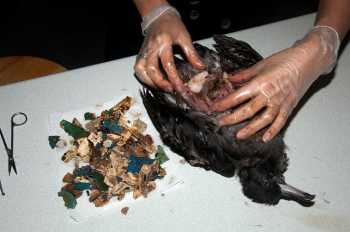 Removing plastic fragments from a Flesh-footed Shearwater chick on Lord Howe Island, photograph by Ian Hutton
Alexander Bond (Bird Group, The Natural History Museum, Tring, United Kingdom) and Jennifer Lavers have published in the journal Environmental Science & Technology on the global significance of plastic pollution impacts on Near Threatened Flesh-footed or Sable Shearwaters Ardenna carneipes.
The paper’s abstract follows:
“Plastic pollution is a pervasive global threat, yet population-level impacts on wildlife remain poorly resolved for most taxa. Sable Shearwaters (Ardenna carneipes) offer a rare opportunity, exhibiting some of the highest documented plastic burdens of any seabird and demonstrating clear physiological and demographic harm even at low exposure levels. Their case reveals that the widespread assumption of minimal plastic impact is largely founded on a lack of evidence rather than evidence of no effect, driven by the difficulty of detecting mortality and sublethal effects in complex marine systems. Their shared life history and anatomical traits make their responses to plastics broadly indicative of what many species may experience as global plastic inputs continue to rise. As international policy efforts stall, these findings highlight the urgency of anticipatory, rather than reactive, research and governance. Extreme-exposure systems like Sable Shearwaters provide essential early warning signals that must inform rapid conservation and regulatory action.”
Reference:
Bond, A.L. & Lavers, J.J. 2026. When absence of evidence is not evidence of absence: what an advanced case reveals about plastic impacts on seabirds. Environmental Science & Technology doi.org/10.1021/acs.ujest.5c17272.