
 English
  Français
  Español
 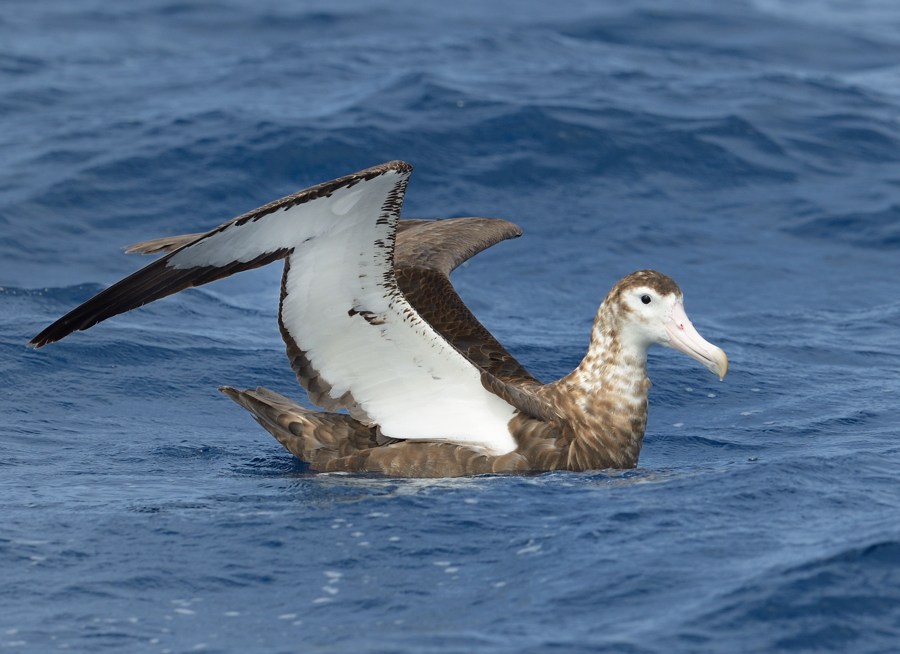 Antipodean Albatross off North Cape, New Zealand, photograph by Kirk Zufelt
Ho Fung Wong (Ocean Futures Research Cluster, University of the Sunshine Coast, Sippy Downs, Queensland, Australia) and colleagues have published open access in the journal Biological Conservation on interactions between Endangered Antipodean Albatrosses Diomedea antipodensis satellite tracked from Antipodes Island and fishing vessels in the South Pacific Ocean.
The paper’s abstract follows:
“Fisheries bycatch poses a major threat to marine predators and remains a global challenge to sustainable fisheries. Conservation and management strategies can be informed by identifying zones of overlap between fishing effort and threatened, endangered or protected species, or existing bycatch hotspots. However, few studies have incorporated ocean data and the age and sex classes of seabirds into these assessments. Here, we examined the environmental conditions that drive fisheries interaction risk for the endangered Antipodean albatross (Diomedea antipodensis antipodensis). Specifically, we assessed interaction risk by combining satellite-tracking data from 192 individuals across age and sex classes of all life stages with data from the Automatic Identification System (AIS) vessel-tracking program. The integration of satellite-tracking and oceanographic data facilitated assessment of how physical ocean features — such as recurring thermal fronts, turbulent ocean mixing, and swirling eddies — shaped high-risk interaction zones. Hotspots of interaction risk spanned from 25°S to 40°S and varied seasonally. Overall, interaction risk was significantly higher during May–August and among juveniles. Over broad climatological scales, the interaction risk was greatest where thermal fronts occur frequently. At finer scales, interaction risk was intensified in association with aggregative Lagrangian Coherent Structures. These findings suggest that Regional Fisheries Management Organisations could take immediate action, such as extending current bycatch mitigation measures to include fishing grounds between 25 and 30°S, to cover the hotspots for juvenile and female seasonally. Incorporating measures of mesoscale ocean dynamics in delineating zones of interaction risk for species of conservation concern provides a potential step forward for dynamic threat management.”
Reference:
Fung Wong, H., Schoeman, D., Miller, P.I., Bentley, L., Halpin, L., Fischer, J.H., Debski, I., Bose, S., Elliott, G., Walker, K. & Scales, K.L. 2026. Mesoscale ocean dynamics structure fisheries interaction risk for an endangered seabird. Biological Conservation 313. 111574.
John Cooper, Emeritus Information Officer, Agreement on the Conservation of Albatrosses and Petrels, 30 December 2025