
 English
  Français
  Español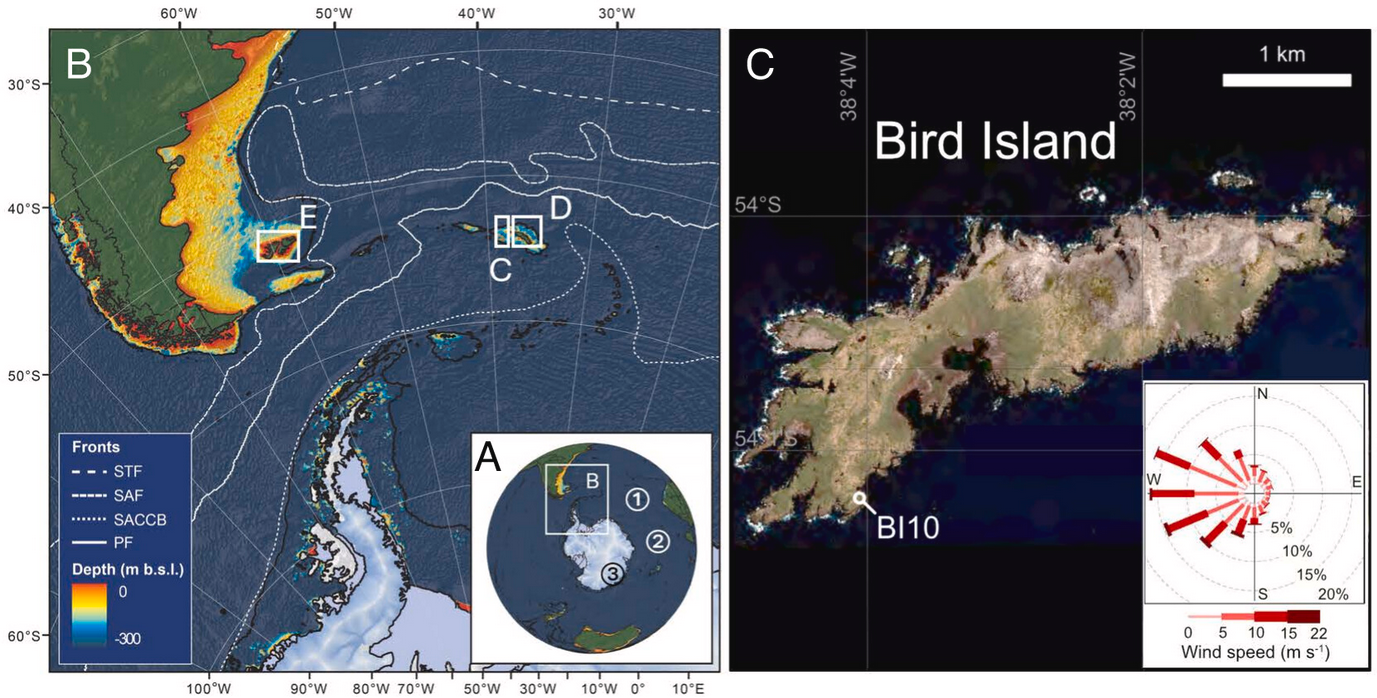
The valley peatland study site on Bird Island in the South Atlantic
Chuxian Li (Department of Aquatic Sciences and Assessment, Swedish University of Agricultural Sciences, Uppsala, Sweden) and many colleagues have published in the open access journal PNAS on a study which indicates that contemporary intensified westerly winds may cause steep declines in Southern Ocean seabird populations.
The paper’s abstract follows:
“The Southern Ocean is home to vast seabird populations and threatened species. To understand the wider impact of the catastrophic decline in many seabird populations over recent decades, we need knowledge of their long-term population dynamics under natural climate variability. We do this by studying mercury flux and stable isotope fingerprints in seabird excrement (guano) that has accumulated in peatland archives around the nest sites. We find that oscillations in peat mercury accumulation reflect guano inputs and therefore seabird abundance. The peat records suggest that seabirds thrived when the Southern Hemisphere westerly winds were less intense. From a past to future perspective, our study indicates that contemporary intensified westerly winds may cause further steep declines in Southern Ocean seabird populations.”
With thanks to Richard Phillips.
Reference:
Li, C. et al. 2026. Southern Ocean seabird population shifts over the Holocene revealed by peat sequestration of mercury from guano. PNAS 123 (16) e253368112.
John Cooper, Emeritus Information Officer, Agreement on the Conservation of Albatrosses and Petrels, 21 April 2026