
 English
  Français
  Español
  Chris Jones takes a rest on Grey-headed Albatross Ridge, Marion Island, photograph by Michelle Risi
Chris Jones is a PhD student at the FitzPatrick Institute of African Ornithology at South Africa’s University of Cape Town. Following a decade of seabird research on both sub-Antarctic and tropical oceanic islands in the Atlantic and Indian Oceans carried out with his wife and fellow PhD student, Michelle Risi, he has now commenced his doctoral study on how breeding-site climate may affect surface-nesting albatrosses on sub-Antarctic Marion Island. Below, Chris describes his thesis research to ACAP Latest News
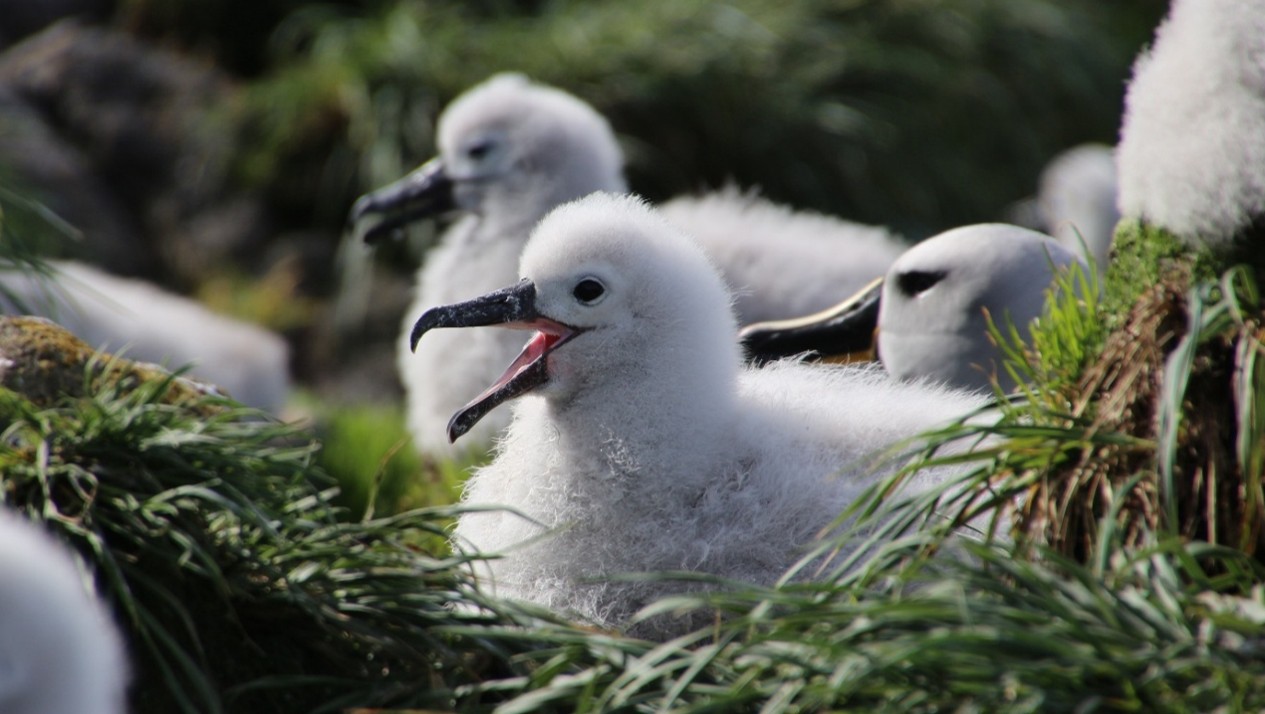 A Grey-headed Albatross chick pants to cool down on Marion Island, photograph by Chris Jones
“Unlike burrowing petrels, which nest underground, these large seabirds incubate their eggs and raise their chicks on the surface, exposed to wind, rain, cold and, increasingly, warmer conditions. The FitzPatrick Institute’s Hot Birds Research Project, co-led by the institute’s Director, Associate Professor Susan Cunningham, is investigating how changing climate at breeding sites may affect these iconic Southern Ocean seabirds. The project combines long-term seabird monitoring with direct observations, miniature weather stations, black-bulb temperature loggers that represent the heat load experienced by birds, nest-site measurements and fine-scale microclimate modelling. Together, these approaches will help show how weather affects breeding outcomes, where colonies may be most exposed, and which parts of the Marion Island landscape may provide safer refuges as the climate changes.”
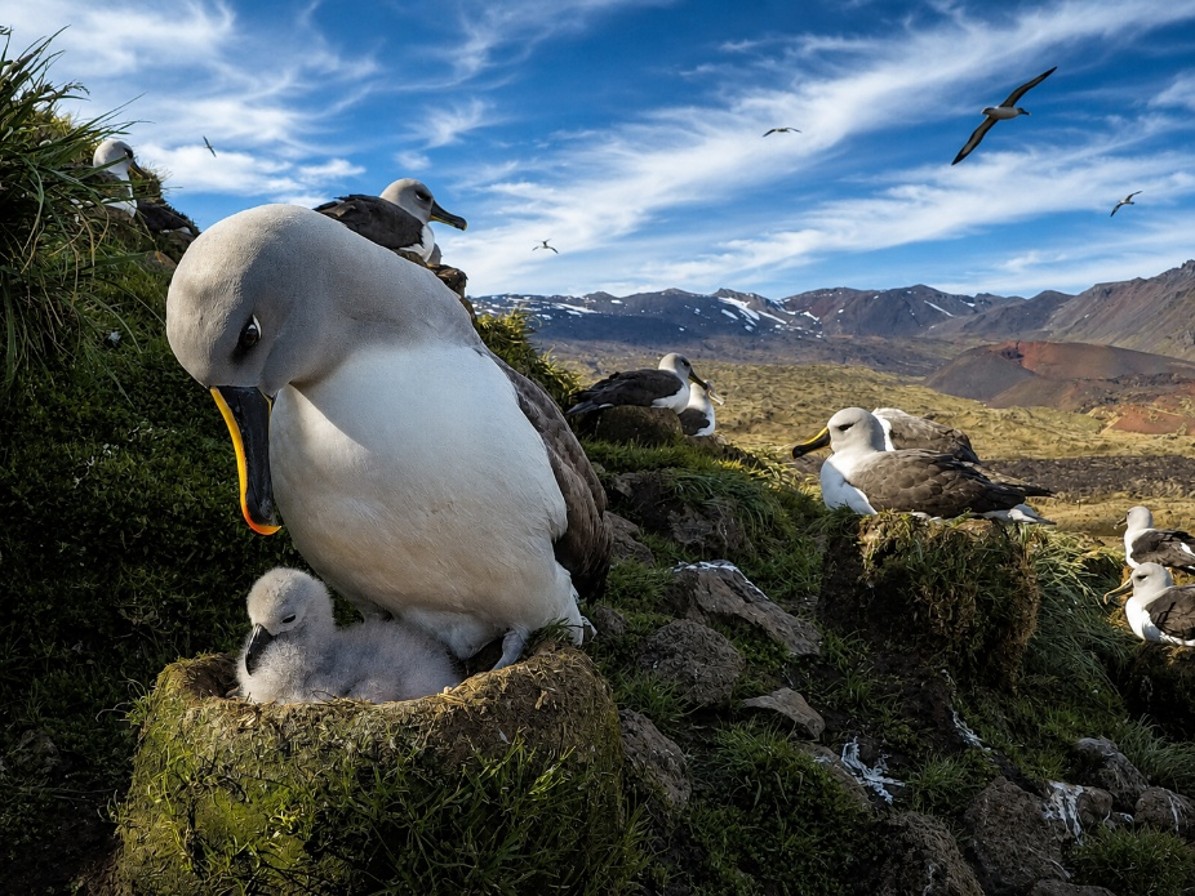
Grey-headed Albatross Ridge in midsummer on Marion Island, photograph by Chris Jones
Chris continues: “As part of the Hot Birds project, my PhD is focused mainly on albatrosses, particularly the Endangered Grey-headed Albatross Thalassarche chrysostoma which breeds on steep ridges on Marion Island. Preliminary results suggest that where a chick sits on the slope matters. Nests higher up the east-facing Grey-headed Albatross Ridge are warmer than those lower down, because the lower tiers are shaded earlier in the day. Chicks in the upper part of the colony appear less likely to survive when daily maximum air temperatures rise above about 14–16°C, whereas chicks lower down the slope seem less affected, likely because they experience a shadier microclimate. I will investigate which air temperatures, heat-load conditions and weather patterns are linked to thermoregulatory behaviours such as panting, and whether these conditions predict breeding failure. I will also test how well microclimate models reproduce field-measured temperature and humidity, map areas of potential climate exposure and refuge across breeding habitats and assess how breeding-site climate exposure could affect the long-term population dynamics of Grey-headed Albatrosses. A further part of my PhD will examine whether nest-scale microclimate affects breeding outcomes in Marion’s winter-breeding Vulnerable Wandering Albatrosses Diomedea exulans.”
Chris’ PhD research is being supervised by Susan Cunningham, Emeritus Professor Peter Ryan (former Fitztitute Director) and Dr Shannon Conradie, a Senior Lecturer in the School of Animal, Plant and Environmental Sciences, University of the Witwatersrand, and long-term member of the Hot Birds Research Project team.
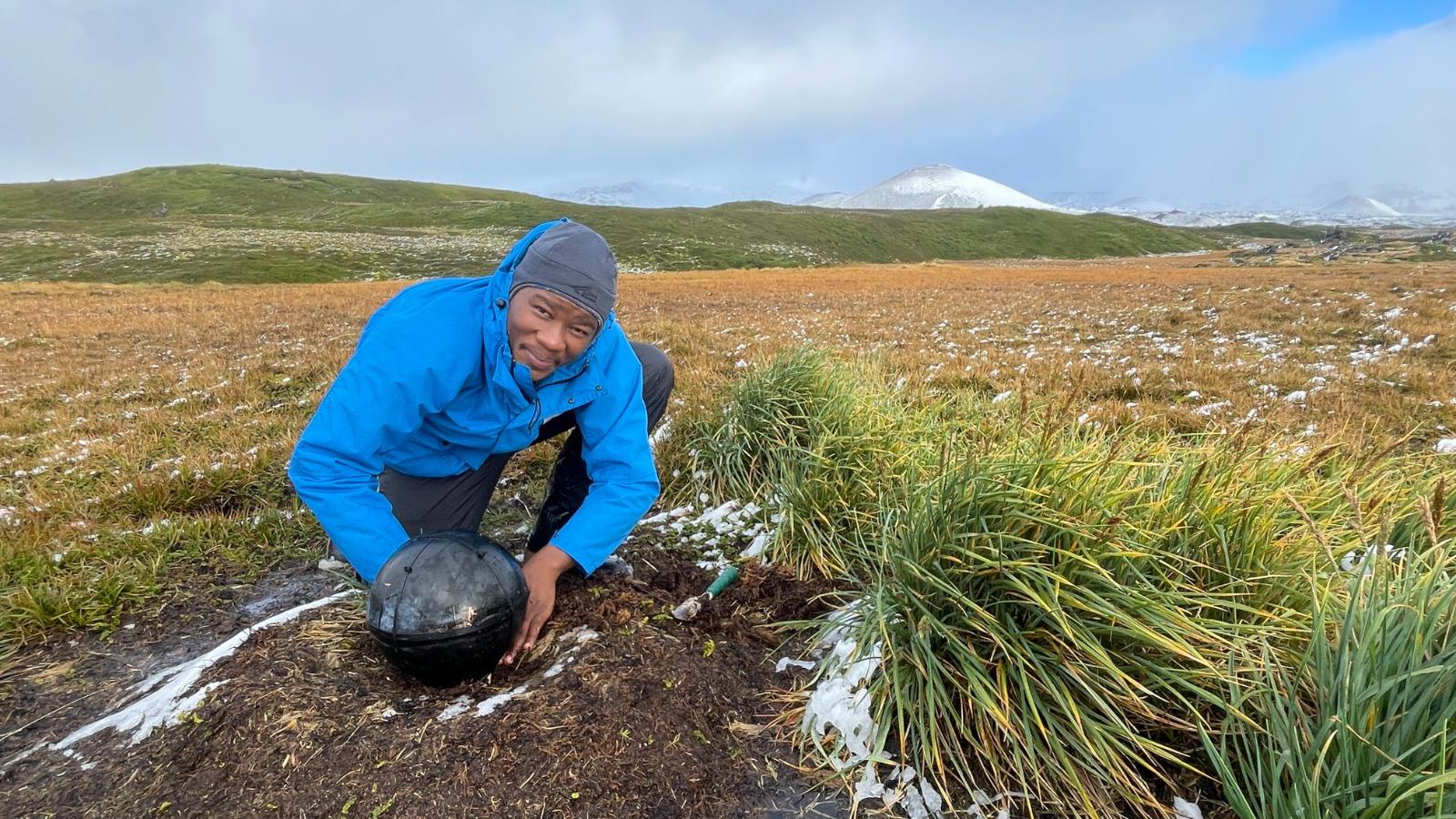 Avumile Bawuli on Marion Island with a black-bulb temperature logger used to estimate operative temperature - the thermal conditions experienced by a bird - on an empty nest
Also part of the Fitztitute’s Hot Birds Research Project is Avumile Bawuli, who overwintered on Marion Island in 2025/26 and is expected to begin his Master’s degree in 2027. His work will focus on giant petrels Macronectes spp. that breed on Marion Island’s open slopes and coastal plains. Avumile will investigate how air temperature and the temperature experienced at the nest relate to the body temperature of giant petrel chicks, helping to identify when chicks are able to maintain safe body temperatures and when they may begin to experience heat stress. He will also investigate chick hydration, testing to what extent warmer conditions increase the risk of dehydration. A second part of his project will focus on Northern Giant Petrels M. halli, comparing current nest-site measurements with data collected in the same colonies in 2003 by John Cooper and Nico de Bruyn (but never published). This will allow him to ask whether nest-site use has changed over the past two decades, and whether particular nest features, such as shelter from prevailing weather provided by protruding rocks, are linked to breeding success.
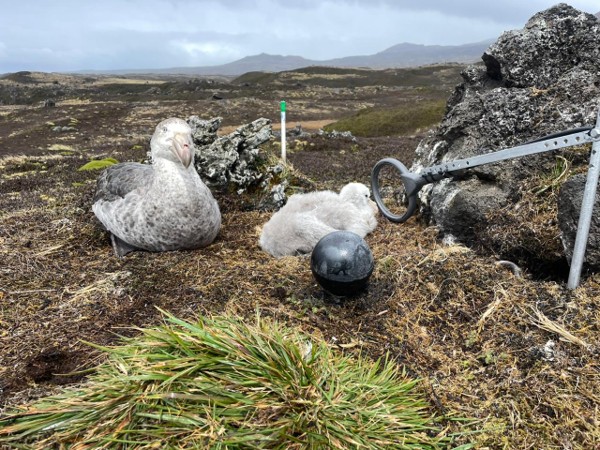 A Northern Giant Petrel nest next to a rock on Marion Island showing a black-bulb temperature logger and a reader used to record the body temperature of the chick that has been fitted with a PIT-tag thermometer, photograph by Avumile Bawuli
Together, Chris and Avumile’s research will help explain how changing weather on Marion Island may affect surface-nesting seabirds, from the scale of the bird and nest to the colony and, ultimately, the population.
With thanks Susie Cunningham.
John Cooper, Emeritus Information Officer, Agreement on the Conservation of Albatrosses and Petrels, 22 July 2026