
 English
  Français
  Español
 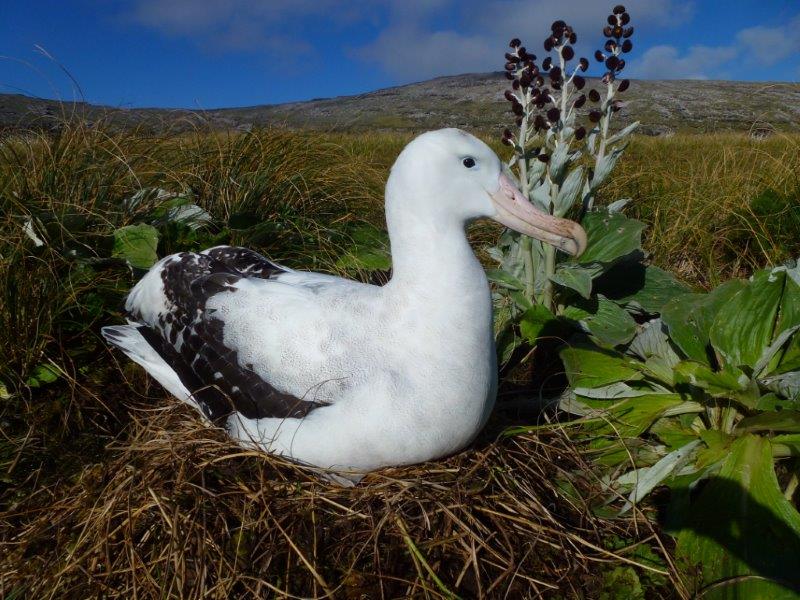 An Antipodean Albatross breeds next to the megaherb, Lance-leaf Button Daisy Pleurophyllum hookeri, on Adams Island, Auckland Island, photograph by Colin ODonnell
UPDATE:
New Zealand introduced a report (UNEP/CMS/COP15/Doc.31.2.9) to the Committee of the Whole (CoW) at the Fifteenth Meeting of the Conference of Parties (COP15) of the Convention on Migratory Species on implementation of the Concerted Action for the Endangered Antipodean Albatross Diomedea antipodensis (UNEP/CMS/Concerted Action 13.12) that had been submitted by the Governments of Australia, Chile and New Zealand, noting engagement with fisheries and improved understanding with tracking tools (see below). The Secretariat of the Pacific Regional Environment Programme and the Agreement on the Conservation of Albatrosses and Petrels (ACAP) supported the proposed Concerted Action. The CoW then submitted the report to the COP, which formally approved the Concerted Action at its final plenary meeting on 29 March.
**************************************
The Convention on Conservation of Migratory Species of Wild Animals (CMS, also known as the Bonn Convention) is considering a report (UNEP/CMS/COP15/Doc.31.2.9, also available in French and Spanish) on the Endangered Antipodean Albatross Diomedea antipodensis (listed on CMS Appendix I) at its Fifteenth Meeting of the Conference of Parties (COP15), being held this week in Campo Grande, Brazil. The 16-page report on implementation of the Concerted Action for the albatross, (UNEP/CMS/Concerted Action 13.12) adopted at COP13 in 2020, has been submitted by the Governments of Australia, Chile and New Zealand. Its Summary follows:
“This report provides the third implementation update for the Antipodean albatross Concerted Action. Good progress towards achieving the various fisheries management and research objectives is reported. In particular, a number of new domestic fisheries management measures have been implemented and intensive satellite tracking has identified key areas of overlap with fishing activity in the high seas. However, progress in addressing high seas fishery bycatch (the greatest threat) remains limited and population monitoring shows no recovery. As such, a revised Concerted Action is proposed for the next intersessional period, with a particular focus on addressing high seas fishery bycatch.”
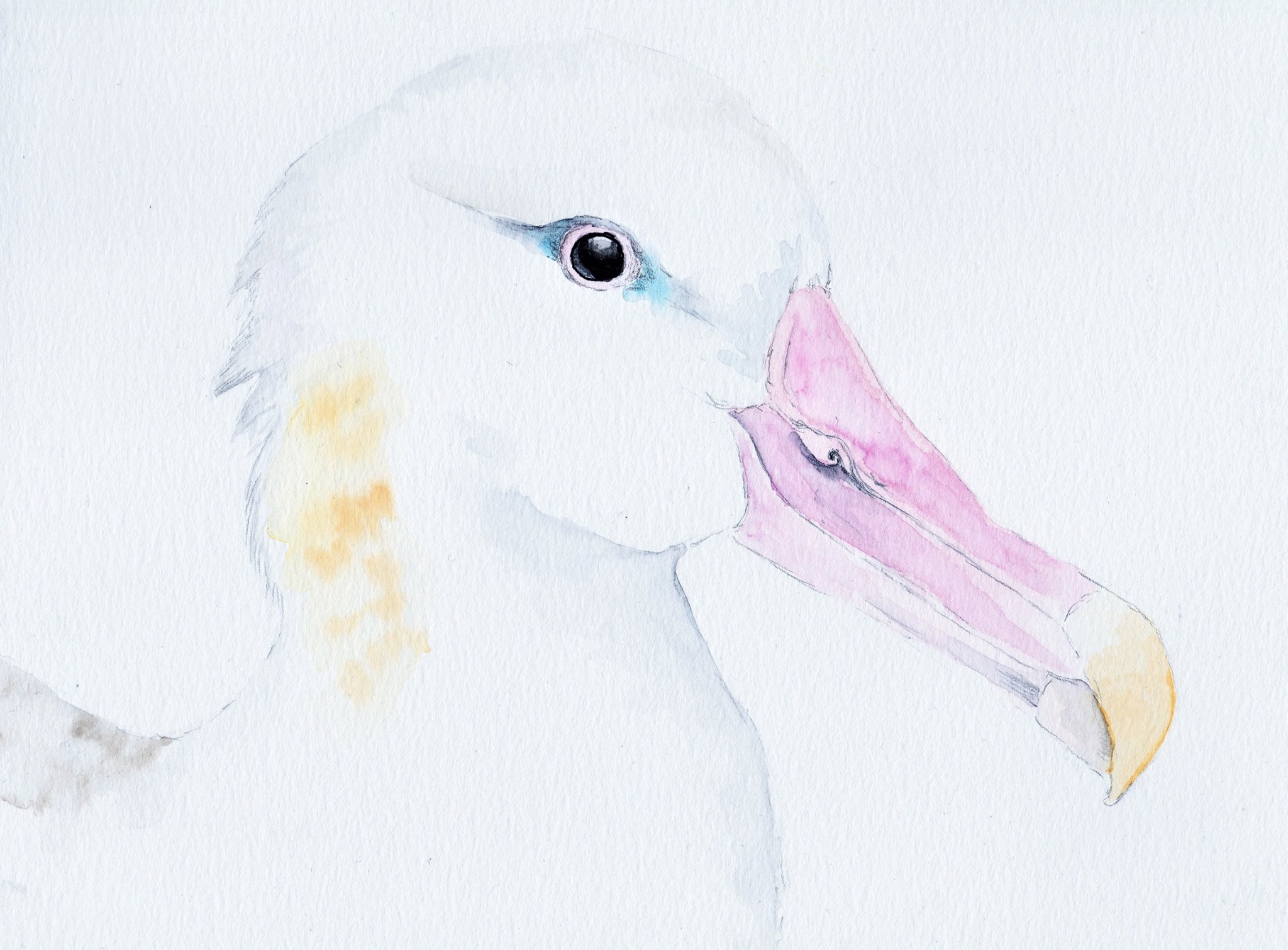 Antipodean Albatross, artwork by Lea Finke for the inaugural World Albatross Day on 19 June 2020, after a photograph by Kirk Zufelt
The report ends with a call for action: “Given the lack of recovery of Antipodean albatross, and the slow progress in addressing the greatest threats (fisheries bycatch in the high seas), we propose an updated Concerted Action is endorsed for the next intersessional period. The updated Concerted Action will guide and prioritise future actions, in particular towards addressing the threat of fisheries bycatch in the high seas.”
"CMS Appendix I comprises migratory species in danger of extinction in the wild throughout all or a significant portion of their range. Parties that are Range States to a migratory species listed on Appendix I endeavour to strictly protect them by prohibiting the taking of such species (including the deliberate killing, capture or disturbance), with a very restricted scope for exceptions; conserving and, where appropriate, restoring their habitats; preventing, removing or mitigating obstacles to their migration; and controlling other factors that might endanger them" (click here).
Access ACAP's report (UNEP/CMS/COP15/Inf.10.3.2) to COP15 here. In its report ACAP welcomes the third report on the implementation of, and proposal for, a continuation of the Concerted Action for the Antipodean Albatross. It also notes the proposal for a Concerted Action for the Flesh-footed Shearwater Ardenna carneipes that links to the proposal for the listing of this species on Appendix II (read more here).
John Cooper, Emeritus Information Officer, Agreement on the Conservation of Albatrosses and Petrels, 25 March 2026, updated 02 April 2026