
 English
  Français
  Español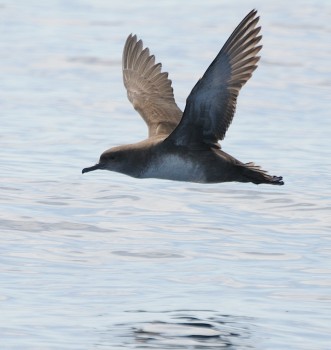
Balearic Shearwater at sea, photograph by ‘Pep’ Arcos
Alice Bernard (Centre d'Ecologie Fonctionnelle et Evolutive, Université de Montpellier, France) and colleagues have published in the journal Biological Conservation on overlaps between migration routes of Critically Endangered (and ACAP-listed) Balearic Shearwaters Puffinus mauretanicus and Northern Gannets Morus bassanus and offshore wind farms.
The paper’s abstract follows:
“Studying fine-scale movements of seabirds during migration is logistically challenging, but GPS technologies allow accurate tracking of individuals on their migratory journeys. Such data provide essential information in the context of offshore wind farm (OWF) developments, notably to anticipate spatial OWF overlap with migratory corridors and main foraging areas used along the routes of vulnerable species. Using high-precision GPS-GSM tags, we investigated the end of summer, southbound migration of two emblematic seabirds of French waters: Juvenile and adult Northern gannets Morus bassanus, and adult Balearic shearwaters Puffinus mauretanicus. Both species travel along the Southwestern European coast, between the Bay of Biscay and Western Africa, or the Mediterranean Sea. Adult gannets thereby migrate through the EEZ of up to 10 countries, six for juvenile gannet, and four for shearwaters. Combining behavioural segmentation based on hidden Markov models and utilization distribution modelling, we found that between two and 6 % of migration routes overlapped with proposed OWFs, with similar impacts on transit and foraging/resting areas. Studied seabirds were most at risk within Portuguese compared to Spanish waters, as they flew closest to OWFs (<10 km on average). While massive OWF developments are being planned within Western European coastal areas, our study suggests that offshore developments should be set >22 km away from the coast, to preserve transnational seabird migratory corridors.”
Reference:
The responsibility of Western European coastal states for the conservation of two emblematic migratory seabirds in the context of offshore wind farms. Biological Conservation 314: 111678 doi.org/10.1016/j.biocon.2025.111678.
John Cooper, Emeritus Information Officer, Agreement on the Conservation of Albatrosses and Petrels, 13 February 2026