
 English
  Français
  Español
 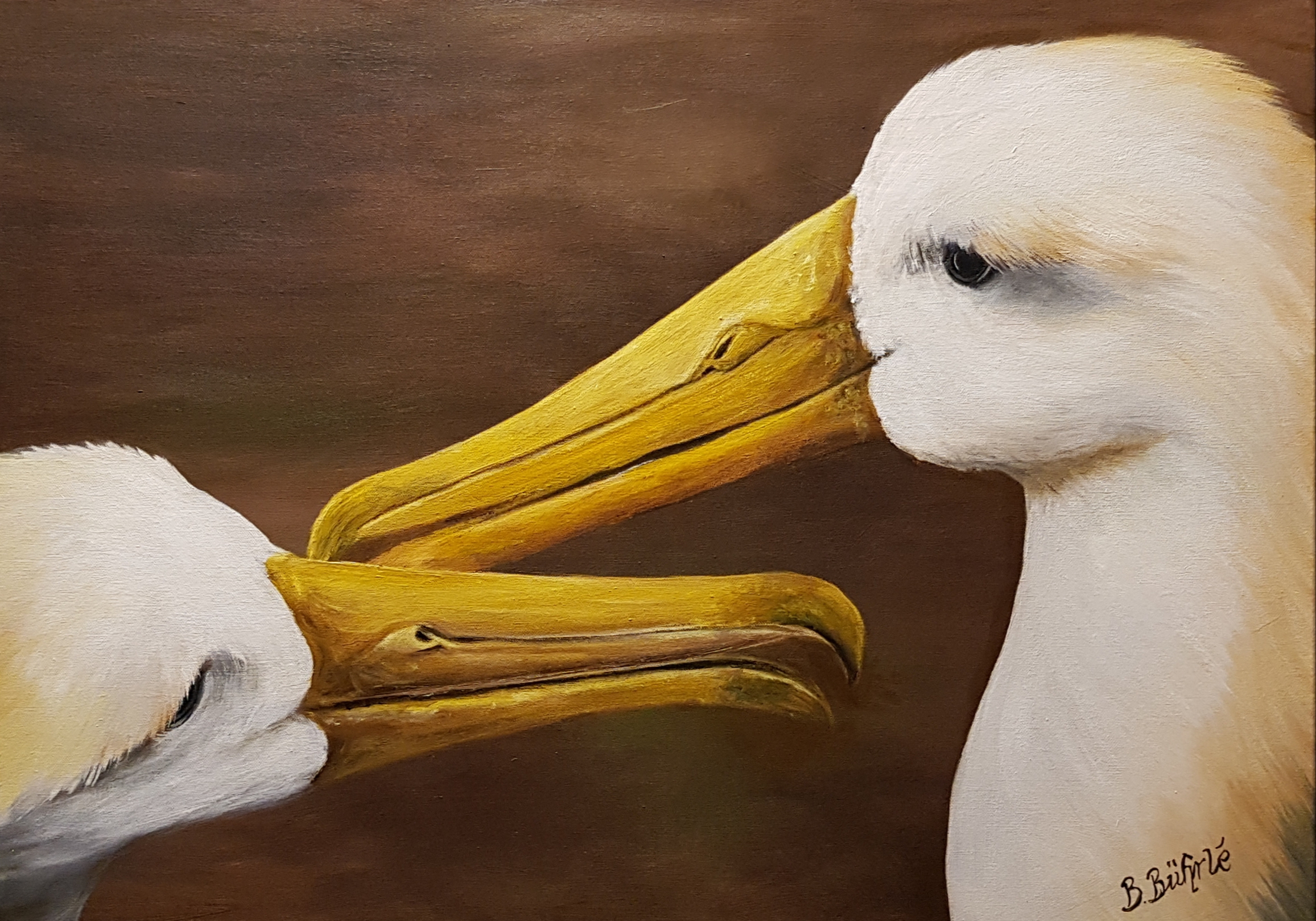 A Waved Albatross pair, artwork by Birgit Bührlé of Artists & Biologists Unite for Nature (ABUN) for the inaugural World Albatross Day on 19 June 2020, after a photograph by Laurie Smaglick Johnson
Jonathan Handley (BirdLife International, Cambridge, UK) and colleagues have reviewed open access in the journal Biological Conservation the intentional take of migratory seabirds for human consumption, finding records for 105 species. For the tubenose order, Procellariiformes, it was found that 22 of 92 reviewed species were subject to take. Three ACAP-listed species, Critically Endangered Waved Albatross Phoebastria irrorata, Vulnerable Pink-footed Shearwater Ardenna creatopus and Endangered Westland Petrel Pterodroma westlandica are recorded as subject to intentional take.
The review states that “The ACAP Working Group on Population and Conservation Status could be the most appropriate group for considering seabird take recommendations for the three ACAP-listed species with records of take.”
The paper’s abstract follows:
“Addressing the threat posed by the exploitation of migratory species is challenging because many move across national boundaries. To inform directions to tackle this threat for migratory species in the most threatened group of birds, seabirds, we conducted a global literature review to evaluate the scale and drivers of intentional take of migratory seabirds (318 of 365 species). The review follows the recent recognition that “hunting and trapping” is the fourth biggest threat to seabirds, and that the nature and severity of seabird take are poorly understood. We investigated reported population impacts, any reporting, management or enforcement measures in place, and any health risks associated with consuming seabirds. Across at least 56 countries/territories, 105 migratory species are subject to take, with adults and eggs taken most. The majority of documented take is legal or of unknown legal status and is conducted by Indigenous Peoples and local communities (IPLC) for subsistence. Illegal take was primarily associated with poachers and fishers. A minority of records included data on the number of birds taken or the presence of management or enforcement mechanisms. While seldom documented, some seabird populations subject to take are in decline or have been extirpated. Human health risks were typically associated with IPLCs consuming seabirds with heavy metals. Similar
ly for other migratory species, key knowledge and governance gaps to understand and manage seabird take include review of species action plans, listing of species on appendices of international agreements, co-management of harvest sites, and improving monitoring to facilitate evidence-based conservation action.”
Reference:
Handley, J.M., Morten, J., Baker, G.B., Küehl-Stenzel, A., Djondo, M.K., Taylor, G.A., Ramirez, I., Frisch-Nwakanma, H., Kümpel, N. F. & Davies, T.E. 2026. Intentional take of seabirds for human consumption: a global review to inform conservation and policy needs for migratory species. Biological Conservation 316, doi.org/10.1016/j.biocon.2026.111740.
John Cooper, Emeritus Information Officer, Agreement on the Conservation of Albatrosses and Petrels, 06 April 2026