
 English
  Français
  Español
 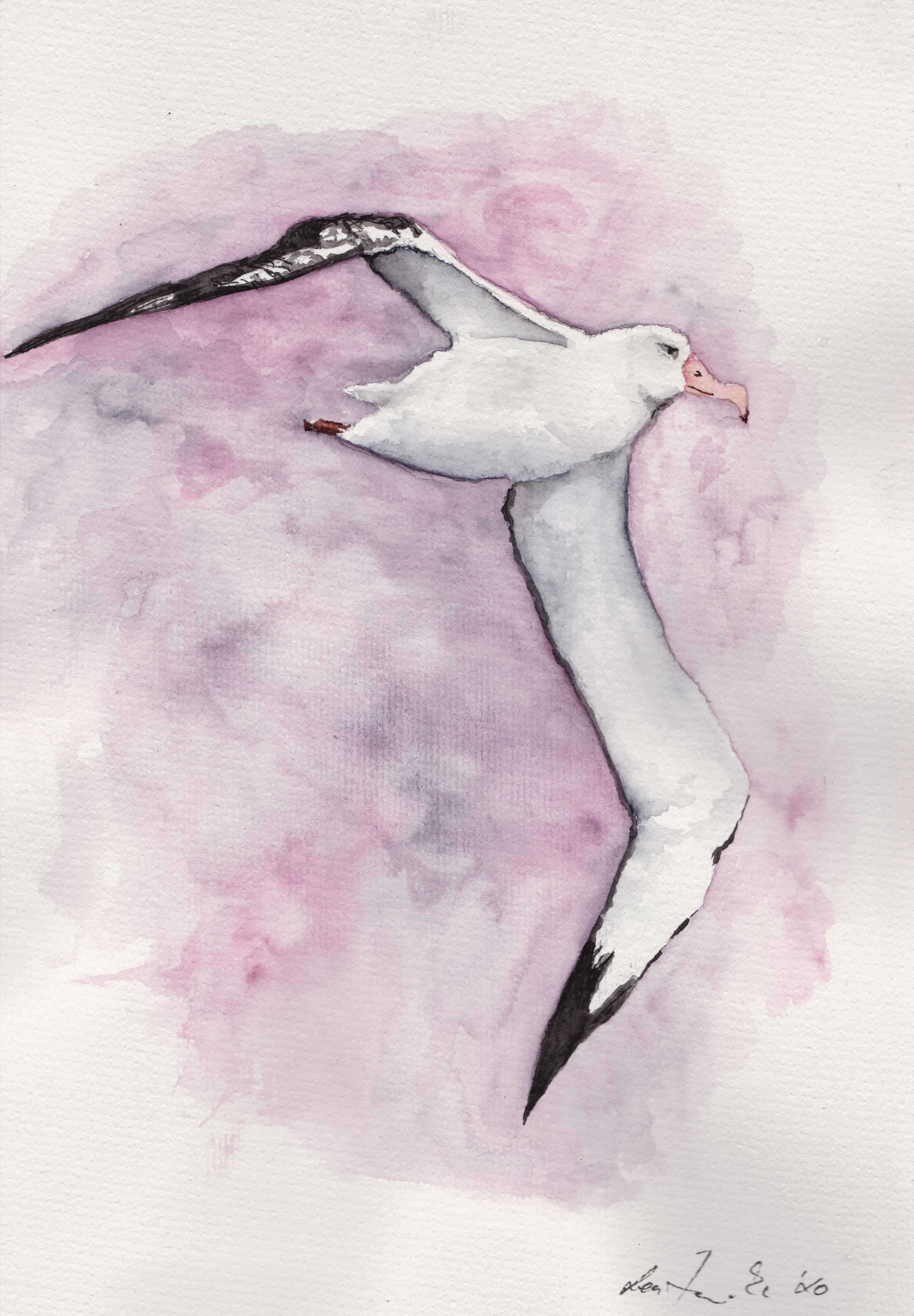 Wandering Albatross by Lea Finke of Artists & Biologists Unite for Nature (ABUN) for the inaugural World Albatross Day on 19 June 2020, after a photograph by Kirk Zufelt
Victoria Warwick-Evans (British Antarctic Survey, Cambridge, UK) and colleagues have published open access in the journal Conservation Biology on the overlap between fisheries and Vulnerable Wandering Albatrosses Diomedea exulans from two different colonies in the South Atlantic.
The paper’s abstract follows:
“Bycatch in fisheries is one of the most serious threats to pelagic seabirds, causing major population declines. Mitigation measures can reduce bycatch substantially, but many fisheries fail to apply best practices, and seabird mortality remains high. Seabirds often segregate at sea according to sex and life-history stage, and bycatch risk can vary accordingly. Few studies have tested whether spatial segregation among colonies in foraging areas affects bycatch risk. We tracked nonbreeding wandering albatrosses (Diomedea exulans) from Bird Island and neighboring Prion Island, South Georgia, to investigate whether differences in at-sea distributions and overlap with fisheries explain the contrasting population trends. Tracked individuals at Bird Island were of known status (immature or nonbreeding adults), and at Prion Island, they were most likely older immatures and potentially a few nonbreeding adults. There was marked spatial segregation between age classes at Bird Island, but the pattern between breeding sites was more complex. The overlap with fisheries was highest in nonbreeding adults from Bird Island, which experienced a faster rate of population decline than at Prion Island, where overlap with fisheries was lower. Overlap was highest with Chinese, South Korean, and Taiwanese squid jiggers, Taiwanese pelagic longliners, and Argentinian and Spanish trawlers. By improving our knowledge of the spatiotemporal overlap of seabirds with fisheries, management initiatives can be directed at the fleets that represent the greatest threats.”
With thanks to Richard Phillips.
Reference:
Warwick-Evans, V., Pearmain, E.J. & Phillips, R.A. 2026. Overlap of nonbreeding wandering albatrosses with fisheries and implications for colony-specific population trajectories at South Georgia. Conservation Biology DOI: 10.1111/cobi.70260.
John Cooper, Emeritus Information Officer, Agreement on the Conservation of Albatrosses and Petrels, 27 March 2026