
 Français
  English
  Español
 Influenza aviaire
Current strains of high pathogenicity avian influenza (HPAI H5Nx) spread more rapidly and aggressively than previous variants, causing substantial impacts on both domestic and wild birds, and even infecting wild mammals. Since 2021, these strains have exhibited unprecedented global spread among seabird populations. The dynamic and unpredictable nature of avian influenza, particularly when it infects naïve populations, can lead to unforeseen consequences, and continuous outreach and information dissemination is needed. General biosecurity guidelines for wildlife professionals have been published by the WOAH/FAO Network of Expertise on Animal Influenza (OFFLU), the Scientific Committee on Antarctic Research (SCAR) and other key organizations have also provided valuable resources. However, these guidelines are often broad and may lack the specificity about Procellariiformes needed by professionals working directly with ACAP species or within their habitats, such as researchers, protected area managers, tourist guides, and onboard observers. Moreover, when encountering suspected HPAI cases in remote locations, these professionals frequently lack the basic knowledge or materials required to properly document and investigate such instances. Continuous efforts are essential to disseminate the most accurate information that supports the development of local and regional emergency plans. To this end, the ACAP intersessional group of experts on epidemiology, disease risk assessment, and management—established during AC13—plays a continuous role in advising ACAP on issues related to the ongoing high pathogenicity H5N1 avian influenza panzootic. In November of 2024 we updated the “Guidelines for working with albatrosses and petrels during the high pathogenicity avian influenza (HPAI) H5N1 panzootic” and we provide an up-to-date map and list of cases in albatrosses, petrels, and shearwaters around the world.
Please stay alert for new resources published on this page by the ACAP intersessional group. As new information becomes available and our guidelines are updated, further communication from diverse perspectives will be essential. These initiatives are crucial to preventing the human-mediated spread of HPAI viruses to ACAP species, enhancing surveillance measures, and accurately assessing impacts on ACAP species.
Guidelines for working with albatrosses and petrels during high pathogenicity avian influenza (HPAI) H5Nx panzootic Updated November 2024
Directives pour les activités auprès d'albatros et de pétrels pendant l’épidémie d’influenza aviaire H5N1 Updated November 2023
Directrices para trabajar con albatros y petreles durante influenza aviar H5Nx Updated November 2024
For a regularly updated resource please see:
More information about the database:
Vanstreels RET, Serafini PP, Giacinti J, Younger J, Huyvaert KP, Wille M, Roberts L, Gamble A, Uhart MM (2026) A public database to monitor the spread and impacts of high pathogenicity avian influenza viruses on albatrosses and petrels. Biodiversity Data Journal 14: e186836. https://doi.org/10.3897/BDJ.14.e186836
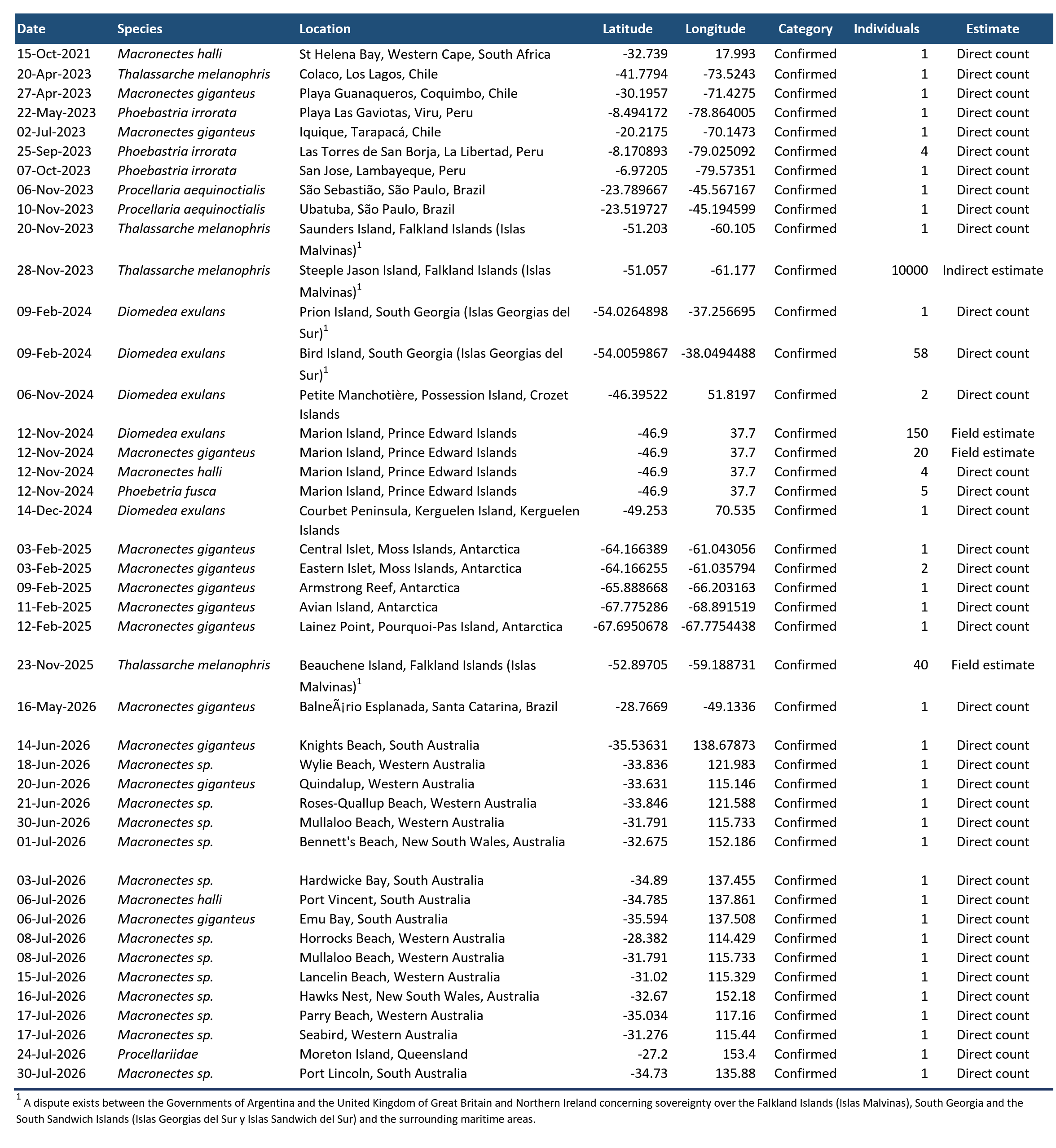
Summary of recent HPAI cases in ACAP species (updated 31 July 2026). Data from
© 2024 ACAP. All rights reserved. Privacy Policy Manage Your Data LoginLogout